Syntax Overview
Someone was asking for an overview of available syntax. I ended up coming this and figured it would be useful to post it here.
It doesn't include everything (notably most tuple expressions and scopes), but it's a good place to start:
It doesn't include everything (notably most tuple expressions and scopes), but it's a good place to start:
import { type } from "arktype"

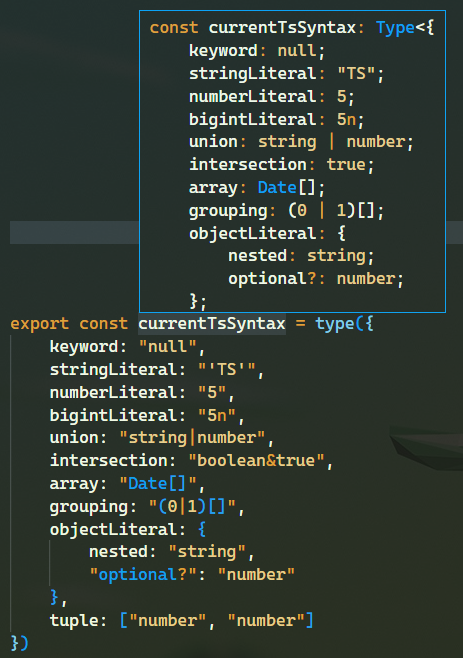
export const currentTsSyntax = type({
    keyword: "null",
    stringLiteral: "'TS'",
    numberLiteral: "5",
    bigintLiteral: "5n",
    union: "string|number",
    intersection: "boolean&true",
    array: "Date[]",
    grouping: "(0|1)[]",
    objectLiteral: {
        nested: "string",
        "optional?": "number"
    },
    tuple: ["number", "number"]
})

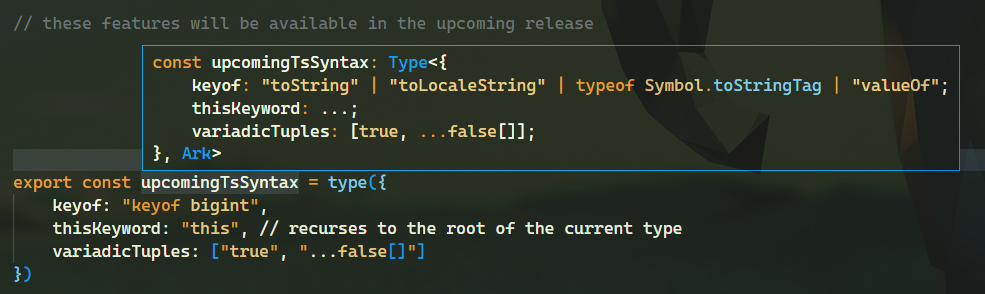
// these features will be available in the upcoming release

export const upcomingTsSyntax = type({
    keyof: "keyof bigint",
    thisKeyword: "this", // recurses to the root of the current type
    variadicTuples: ["true", "...false[]"]
})

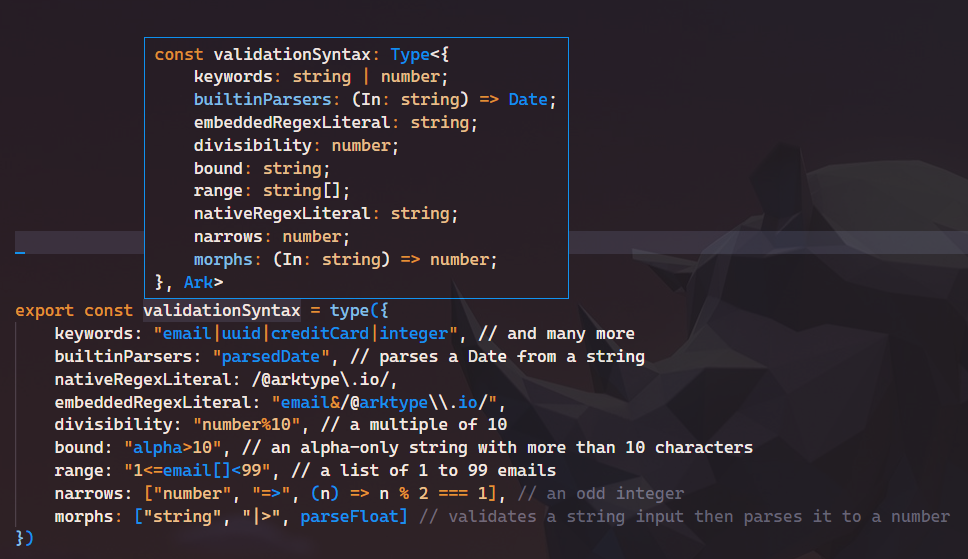
export const validationSyntax = type({
    keywords: "email|uuid|creditCard|integer", // and many more
    builtinParsers: "parsedDate", // parses a Date from a string
    nativeRegexLiteral: /@arktype\.io/,
    embeddedRegexLiteral: "email&/@arktype\\.io/",
    divisibility: "number%10", // a multiple of 10
    bound: "alpha>10", // an alpha-only string with more than 10 characters
    range: "1<=email[]<100", // a list of 1 to 99 emails
    narrows: ["number", "=>", (n) => n % 2 === 1], // an odd integer
    morphs: ["string", "|>", parseFloat] // validates a string input then parses it to a number
})

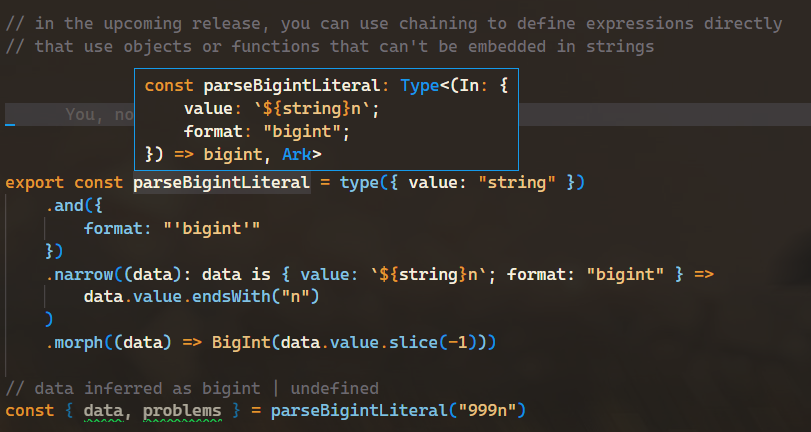
// in the upcoming release, you can use chaining to define expressions directly
// that use objects or functions that can't be embedded in strings

export const parseBigintLiteral = type({ value: "string" })
    .and({
        format: "'bigint'"
    })
    .narrow((data): data is { value: `${string}n`; format: "bigint" } =>
        data.value.endsWith("n")
    )
    .morph((data) => BigInt(data.value.slice(-1)))

// data inferred as bigint | undefined
export const { data, problems } = parseBigintLiteral({value: "999n", format: "bigint"})
import { type } from "arktype"
export const currentTsSyntax = type({
keyword: "null",
stringLiteral: "'TS'",
numberLiteral: "5",
bigintLiteral: "5n",
union: "string|number",
intersection: "boolean&true",
array: "Date[]",
grouping: "(0|1)[]",
objectLiteral: {
nested: "string",
"optional?": "number"
},
tuple: ["number", "number"]
})
// these features will be available in the upcoming release
export const upcomingTsSyntax = type({
keyof: "keyof bigint",
thisKeyword: "this", // recurses to the root of the current type
variadicTuples: ["true", "...false[]"]
})
export const validationSyntax = type({
keywords: "email|uuid|creditCard|integer", // and many more
builtinParsers: "parsedDate", // parses a Date from a string
nativeRegexLiteral: /@arktype\.io/,
embeddedRegexLiteral: "email&/@arktype\\.io/",
divisibility: "number%10", // a multiple of 10
bound: "alpha>10", // an alpha-only string with more than 10 characters
range: "1<=email[]<100", // a list of 1 to 99 emails
narrows: ["number", "=>", (n) => n % 2 === 1], // an odd integer
morphs: ["string", "|>", parseFloat] // validates a string input then parses it to a number
})
// in the upcoming release, you can use chaining to define expressions directly
// that use objects or functions that can't be embedded in strings
export const parseBigintLiteral = type({ value: "string" })
.and({
format: "'bigint'"
})
.narrow((data): data is { value: `${string}n`; format: "bigint" } =>
data.value.endsWith("n")
)
.morph((data) => BigInt(data.value.slice(-1)))
// data inferred as bigint | undefined
export const { data, problems } = parseBigintLiteral({value: "999n", format: "bigint"})