❔ Moq test exception thrown after adding and saved changes to the context object
Exception has occurred: CLR/Moq.MockException
Exception thrown: 'Moq.MockException' in Moq.dll: '
Expected invocation on the mock once, but was 0 times: m => m.Add(It.IsAny<User>())

Performed invocations:

   Mock<DbSet<User>:1> (m):

      DbSet<User>.ToString()
      DbSet<User>.ToString()
      DbSet<User>.ToString()'
   at Moq.Mock.Verify(Mock mock, LambdaExpression expression, Times times, String failMessage)
   at studyPalsTests.UserTests.CreateAccount() in c:\dev\c#\projects\410project\studyPalsTests\UserTests.cs:line 110
Exception has occurred: CLR/Moq.MockException
Exception thrown: 'Moq.MockException' in Moq.dll: '
Expected invocation on the mock once, but was 0 times: m => m.Add(It.IsAny<User>())
Performed invocations:
Mock<DbSet<User>:1> (m):
DbSet<User>.ToString()
DbSet<User>.ToString()
DbSet<User>.ToString()'
at Moq.Mock.Verify(Mock mock, LambdaExpression expression, Times times, String failMessage)
at studyPalsTests.UserTests.CreateAccount() in c:\dev\c#\projects\410project\studyPalsTests\UserTests.cs:line 110public void CreateAccount()
{
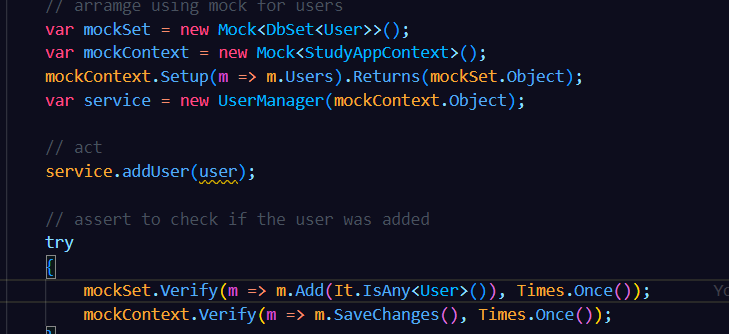
// arramge using mock for users
var mockSet = new Mock<DbSet<User>>();
var mockContext = new Mock<StudyAppContext>();
mockContext.Setup(m => m.Users).Returns(mockSet.Object);
var service = new UserManager(mockContext.Object);
// act
service.addUser(user);
// assert to check if the user was added
try
{
mockSet.Verify(m => m.Add(It.IsAny<User>()), Times.Once()); // exception is thrown here
mockContext.Verify(m => m.SaveChanges(), Times.Once());
}
catch (System.Exception)
{
throw;
}
}public void CreateAccount()
{
// arramge using mock for users
var mockSet = new Mock<DbSet<User>>();
var mockContext = new Mock<StudyAppContext>();
mockContext.Setup(m => m.Users).Returns(mockSet.Object);
var service = new UserManager(mockContext.Object);
// act
service.addUser(user);
// assert to check if the user was added
try
{
mockSet.Verify(m => m.Add(It.IsAny<User>()), Times.Once()); // exception is thrown here
mockContext.Verify(m => m.SaveChanges(), Times.Once());
}
catch (System.Exception)
{
throw;
}
}