Where is the sun?
Thank you for reading these arguments. Of course, please be respectful; I'm just looking for a good-faith debate.
I should clarify that my native language is Spanish and I speak some English.
Personally, I believe that asking where the sun is is the question that most easily refutes the idea that the earth is flat, because it only requires the basic senses and a minimal knowledge of trigonometry.
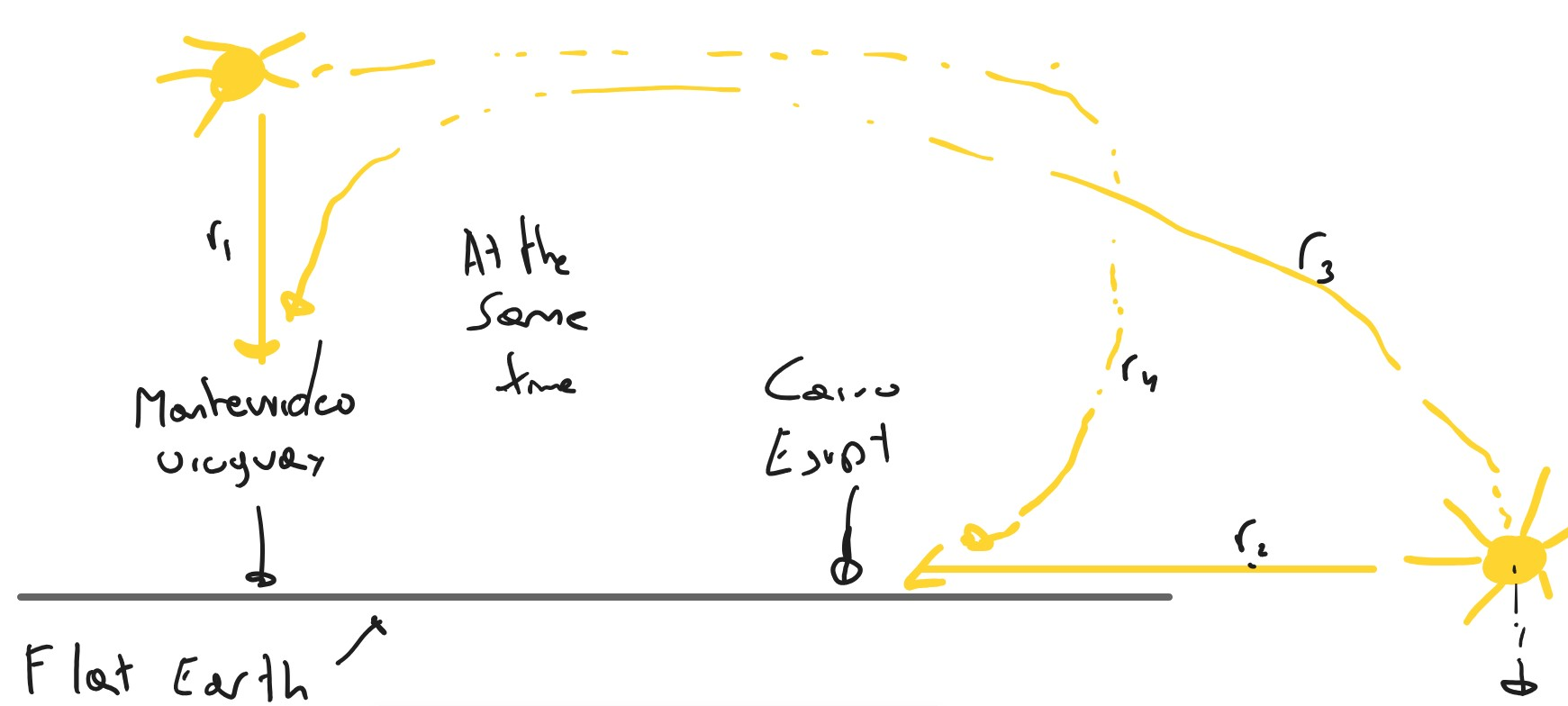
The simplest problem about the flat Earth is: Where is the sun when it is getting dark in one place and the sun can be seen in the middle of the sky in another?
For example:
--------------------------
Montevideo, Uruguay – Sun high
12:28 PM (UTC−3)
Cairo, Egypt – Sunset
4:59 PM (UTC+2)
→ Simultaneous in UTC.
----------------------------
São Luís, Brazil – Sun high
11:41 AM (UTC−3)
Mogadishu, Somalia – Sunset
5:43 PM (UTC+3)
→ Simultaneous in UTC.
------------------------------
How can this be explained?
Is there more than one sun?
Is there a model that explains this inconsistency?
Every day they see the sun set on the horizon and slowly disappear, but at the same time there are places where the sun reaches its highest point. How do they explain this?
You believe in what you can see, and that's why the example of the sun is ideal.
2 Replies
Asking a question is not an argument.
The sun is a light in the sky and is thus non-sequitur to the geometry of Earth's surface.
There is no evidence of the sun having an actual location (as opposed to an apparent one).
You should also know that the horizon is apparent, not geometric.

The sun is in the sky. This is a flat earth server - you know, the stuff under your feet, not a sky stuff server.