6 Replies
@Apu
Note for OP
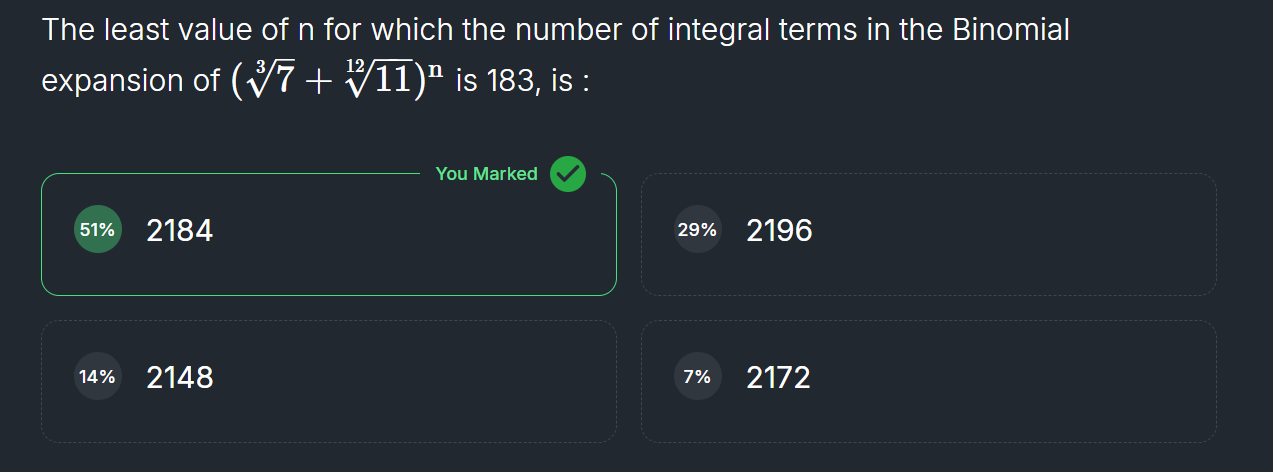
+solved @user1 @user2... to close the thread when your doubt is solved. Mention the users who helped you solve the doubt. This will be added to their stats.let power = 12n (multiple of 12)
then write the expansion :
7^12n/3 + ... + 7^12(n-1)/3 * 11^12/12 + ... + 7^12/3 * 11^12(n-1)/12 + ... + 11^12n/12
now u can count that there will be (n+1) integral terms if the power is 12n
so 183 = n+1 -> n = 182 => 12n = 2184
(ignore binomial coeff we care about powers here)
i didnt write them for sake of simplicity
now u can count that there will be (n+1) integral terms if the power is 12nif this isnt clear notice how 7's power goes from 12n/3, 12(n-1)/3,12(n-2)/3 , ... 0 u count from 1 to n thats n and add a 0 its now n+1
let power = 12n (multiple of 12)did this cuz if u think logically, if we took any other multiple than 12 11^n/12 wont be integral which means to increase integral terms we will need to higher power while 12n gives us one more integer for free or u could just say its intuition lowkey
The thingies where terms are of form (a)^12k.b^(n-12k), are basically when k goes from 0 to floor of n/12, so you have floor of n/12 + 1 terms which you need.
oooo i got it! thanks
thank you too for replying
+solved @AY @SirLancelotDuLac
Post locked and archived successfully!
Archived by
<@1169580341003046928> (1169580341003046928)
Time
<t:1763992858:R>
Solved by
<@928940800178544691> (928940800178544691), <@1075951732460376214> (1075951732460376214)