18 Replies
@Apu
Note for OP
+solved @user1 @user2... to close the thread when your doubt is solved. Mention the users who helped you solve the doubt. This will be added to their stats.@AY this
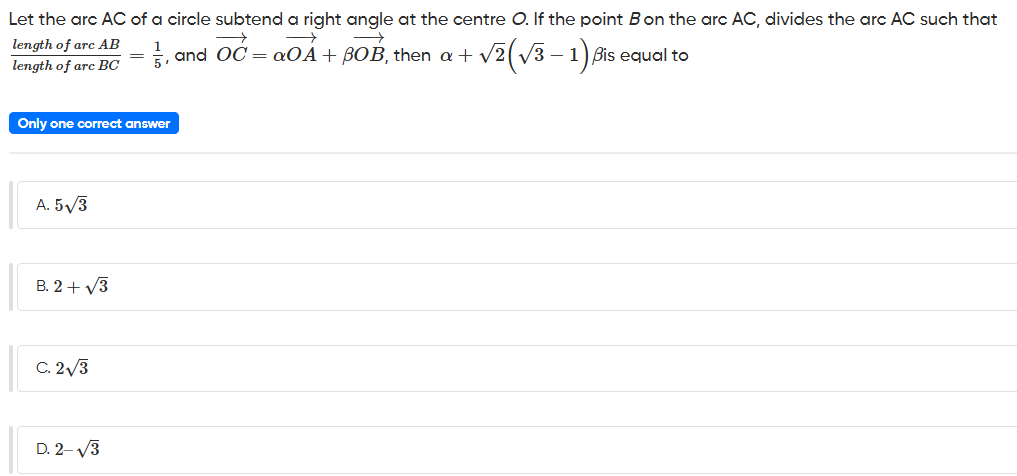
AB : BC = 1:5
so
AB : AC = 1/6
and AC subtends 90 at centre
which means AC is 1/4th of circumfrence
which means AB is 1/6 * 1/4 = 1/24th of circumfrence

we are asked
OC = aOA + bOB
if u break OB into it's components
(btw all vectors here are of length 1 cuz unit circle :p)
(took 1 forn simplicity u can take r)

so aOA + bOB is actually

(geometrically)
so notice how no horizontal component is left everything is vertical
so
a+bcos(t) = 0
and b sin(t) = 1
t = 90/6 or pi/12 (from previous diagram)
b = 1/sin(t)
and
a = -cot(t)
t = 15 degree
a + sqrt(2)(sqrt(3) - 1)b
just sub everthing
cos(30+45) = sin(15)

b is 4/...
and its being multiplied with
...
sqrt(2)(sqrt(3) - 1)so
sqrt(2)(sqrt(3) - 1)this thing is just 4 and cot(t) cot(15) = 2 + sqrt(3) 2 + sqrt(3) - 4 = sqrt(3) - 2 oh mb it was -cot(t) 4-2 - sqrt(3) 2 - sqrt(3) lmao why did this take so long
Solution is as given above lol, but one easy way to do this is just let A be (1,0) and C be (0,1); then B is (cos(pi/6),sin(pi/6))
Then just find the req. value thingy
Oh and then you have OB=cos(thingy)OA+sin(thingy)OC
Rearrange to get alpha beta
oooooooo ok
ill see this properly
Howd you get B is cospi/6, sinpi/6
Basically howd you get the argument as pi/6
pi/12
length of arc proportional to angle, also yeah it should be pi/12 as pointed out by @AY
Ye thats what I calculated initally as well
Thanks