

 D
DThen I will use some alternative
DMeanwhile the app scales
 H
HThat seems extremely high. What are you doing, may I ask?
 D
DI didn't have tested it yet, but from what I've found that's what does it take
 I
IAre you sure you're not confusing CPU and wall time?
I100ms sounds quite high indeed.
I?cpu-time
 F
FCPU Time: the amount of work the CPU needs to do, measured in
Wall Time: the actual amount of time a Worker runs for, as though you measured it with a clock or your browser DevTools
ms. More CPU-heavy things will increase it (hashing passwords). This is not the same as the time a fetchWall Time: the actual amount of time a Worker runs for, as though you measured it with a clock or your browser DevTools
HIt wouldn't really work. Current advice is assume that the global state is nuked for every request. It can be reused over multiple requests, but it definitely isn't behavior you should rely on
HThey wait ~30 seconds, then are cut off.
HThey might get a bit longer, but that's the time you are guaranteed, barring other issues
HYup, that makes sense
HCloudflare Docs
This article includes an overview of Cloudflare security architecture, and then addresses two frequently asked about issues: V8 bugs and Spectre.
HInteract with Cloudflare's products and services via the Cloudflare API
HOr you could do it in reverse, from your API?
HNot sure how useful that is
 S
SIs there something obviously wrong with this function that would cause a 503/1019 error? I have a static nuxt 3 cf pages project that works until I deploy this code in a
/functions/[[catchall]].js. This code logic works when deployed separately as a cf worker but not when translated to a cf pages function.
 W
WWell your fetch is gonna invoke the function again... which will do another fetch and invoke again... and repeat
WI think you want
https://developers.cloudflare.com/pages/functions/api-reference/#envassetsfetch
env.ASSETS.fetchhttps://developers.cloudflare.com/pages/functions/api-reference/#envassetsfetch
Cloudflare Docs
Learn about the APIs used within Pages Functions.
 H
Hdoes middleware count towards your functions quota?
Hadditionally, can i only run middleware on some static files? i'd like it to run before my actual pages get served but not static assets
Hthe documentation just mentions
functions/_middleware.ts for 'all requests, including in front of static files', can't tell if there's any granularity for static files
 J
Jyes, if the function is invoked, it will count towards quota
Jyou could manually specify which routes it runs on with
_routes H
Hexcellent, thank you
Hin that case i won't have to worry about the quota
 M
MI can't seem to figure out from the documentation, but is it possible to prevent a Pages Function from being called from anywhere other than the Page itself? I'm fairly new to web development so I'm not sure if this is a config thing outside of code or something I have to set up in the code of the Pages Function itself
 H
HNot really. While you can use CORS to prevent other websites from calling your Functions, that only works in browsers that respect CORS. Not to mention tools like
curl, or anything that can make HTTP calls. They can be made to respect CORS, but by default do notHYou could also block based on the origin header, but that doesn't preclude someone from setting that header too
MA visitor to the site would be able to see any requests the page makes to a function so I couldn’t use some sort of fixed authentication header right? Maybe a dynamically generated token based off a private key would work
HYour private key would still be present in the source though no? Or at least the token
MOh right…
 C
CHi! Is there a way to use cron with Pages+Functions?
JThere is not, sadly. You’ll have to use a normal Worker for that
 G
Gif i reach the requests limit will my functions just not work or my whole pages website will go down?

 C
CDepends what your functions do (are they just middleware/stuff running in front of static assets)? and your Request Limit failure mode under Settings -> Functions
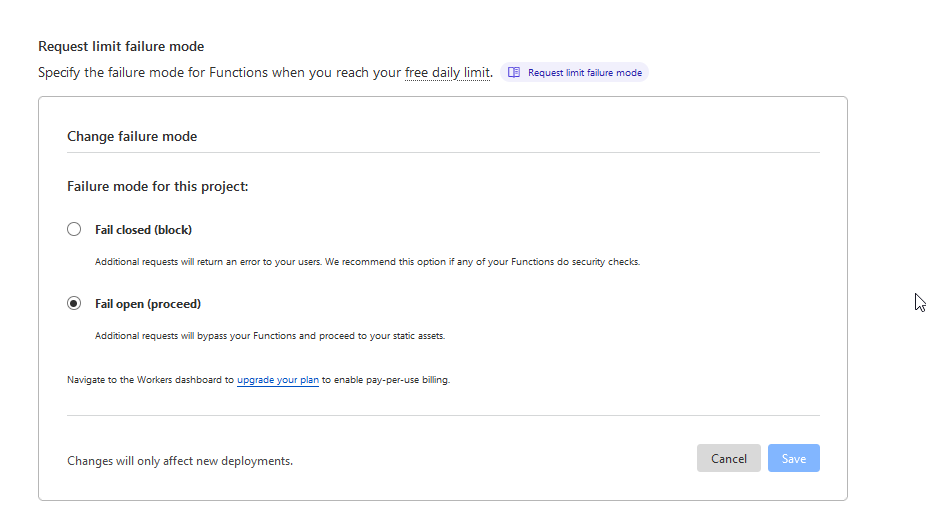
 D
DHey guys, quick question. I'm using Pages to deploy my site in advanced mode, that is with _worker.js file. Currently my framework builds the site with _worker.js directory, meaning that it is not bundled. Does Pages deployment do any bundling before the worker is deployed, or do I have to bundle it myself? Thanks!
DI googled and only found this: https://community.cloudflare.com/t/refactor-a-worker-to-a-pages-function-problem/536838 when one user mentions this, so I want to be just sure 
When using advanced mode, you need to bundle the worker—Cloudflare Pages build system doesn’t handle the bundling (if I recall correctly.)
DSo I may have confirmed this myself, there is no bundling step done automatically. Please correct me if i'm wrong.
 N
NHello everyone, just joined!
Trying to forward my pages app form submissions to an email, do need just a custom domain or do i need to buy some email hosting or something? Total noob when it comed to this stuff
Trying to forward my pages app form submissions to an email, do need just a custom domain or do i need to buy some email hosting or something? Total noob when it comed to this stuff
 A
Acan I use a function/middleware to capture the referer header for anything that 404s on a Cloudflare Pages site?

 S
SPerhaps MailChannels Pages Plugin might help https://developers.cloudflare.com/pages/functions/plugins/mailchannels/
Cloudflare Docs
The MailChannels Pages Plugin intercepts all form submissions made which have the data-static-form-name attribute set. Then, it emails these form …
 T
TI have a service worker and I'm getting in a bit of a muddle trying to pass it some data. Hopefully just being blind but can anyone just point out what I'm missing. Context (or request when destructured out) doesn't contain the data I'm trying to send
