
I will upload in a moment the producer/consumer workers in GitHub.
I will upload in a moment the producer/consumer workers in GitHub.
 M
M T
T C
C C
C R
R M
M S
S SR
SR9 !
!
 DD
DDawaitstep.do JRS
JRS AR
AR F
F AFFAFF
pause 币ASASASA
 A
A
 W
Wconst wf = await MY_WORKFLOW.get(id)await wf.status()
 N
NAn RPC stub was not disposed properly. You must call dispose() on all stubs in order to let the other side know that you are no longer using them. You cannot rely on the garbage collector for this because it may take arbitrarily long before actually collecting unreachable objects. As a shortcut, calling dispose() on the result of an RPC call disposes all stubs within it.step.doRpc.Serializable<unknown>usingobject[Symbol.dispose]()step.do
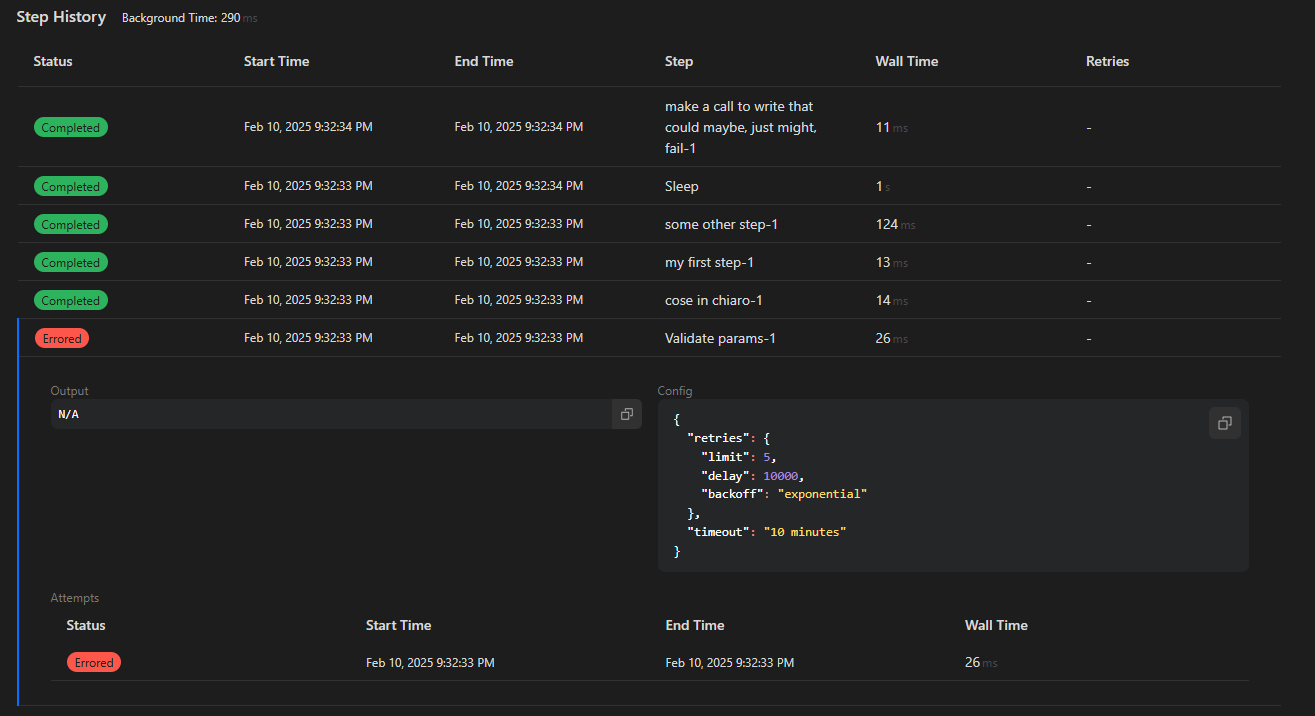
 TA
TA AF
AFsleepsleepstep.do('Validate params', async () => {
if (!event.payload.email) {
throw new NonRetryableError('No email provided');
}
if (!event.payload.url) {
throw new NonRetryableError('No url provided');
}
if (!isValidUrl(event.payload.url)) {
throw new NonRetryableError('Invalid URL');
}
if (!isValidEmail(event.payload.email)) {
throw new NonRetryableError('Invalid email provided');
}
});#!/bin/bash
# Exit immediately if a command exits with a non-zero status
set -e
# Check if workflow name and status are provided
if [ -z "$1" ] || [ -z "$2" ]; then
echo "Usage: $0 <workflow-name> <status>"
echo "Status can be: queued, running, succeeded, failed"
exit 1
fi
WORKFLOW_NAME="$1"
STATUS="$2"
while true; do
# Get workflow instances with specified status
output=$(npx wrangler workflows instances list "$WORKFLOW_NAME" --status="$STATUS" 2>/dev/null)
ids=$(echo "$output" | awk -F '│' '{gsub(/ /, "", $2); if ($2 ~ /^[a-f0-9-]+$/) print $2}')
instance_count=$(echo "$ids" | wc -w | tr -d ' ')
if [ "$instance_count" -eq 0 ]; then
echo "No more instances found with status '$STATUS'"
break
fi
echo "Found $instance_count instances with status '$STATUS'"
# Process in batches
BATCH_SIZE=5
echo "$ids" | xargs -n$BATCH_SIZE -P$BATCH_SIZE -I{} sh -c '
id="$1"
workflow="$2"
if ! npx wrangler workflows instances terminate "$workflow" "$id" >/dev/null 2>&1; then
echo "Failed to terminate instance $id"
exit 1
fi
echo "Terminated $id"
' -- {} "$WORKFLOW_NAME"
echo "Batch complete, checking for remaining instances..."
done
echo "Done terminating all instances"while (true) {
const isDone = await checkIfSomethingIsDone()
if (isDone) break;
step.sleep('wait for event', '5 minutes');
}export class MyWorkflow extends WorkflowEntrypoint<Env, Params> {
async run(event: WorkflowEvent<Params>, step: WorkflowStep) {
step.do('Step 1', async () => { return 'Step 1 finished!'; });
step.do('Step 2', {
retries: { limit: 2, delay: '1 second', backoff: 'linear', },
}, async () => {
console.log('Trying Step 2');
throw new NonRetryableError('Step 3 failed. Non-retryable');
});
}
}An RPC stub was not disposed properly. You must call dispose() on all stubs in order to let the other side know that you are no longer using them. You cannot rely on the garbage collector for this because it may take arbitrarily long before actually collecting unreachable objects. As a shortcut, calling dispose() on the result of an RPC call disposes all stubs within it.export class WORKFLOW_WITH_BATCHED_EVENTS extends WorkflowEntrypoint<Env, BatchPayload> {
async run(event: WorkflowEvent<BatchPayload>, step: WorkflowStep) {
// Can access bindings on `this.env`
// Can access params on `event.payload`
const ctx = this.ctx;
const events = event.payload.data;
// THIS IS THE MAIN STEP, WHICH CONTAINS THE ACTUAL SUB-STEPS, WHAT I MENTIONED BEFORE.
const process_events = await step.do("process_events",
async () => {
/// ITERATE OVER THE EVENTS ONE-BY-ONE
for(const key in events){
const e = events[key];
//SUBSTEPS - Process as usual.
const fbcapi = await step.do(`your_substep_name`,
async () => { ... }
)
//.... the rest of your wf logic
}
//...
})
}interface CycleParams<
I extends Rpc.Serializable<I> = Rpc.Serializable<any>,
O extends Rpc.Serializable<O> = Rpc.Serializable<any>,
> {
name: string;
do: {
name: string;
callback: (data: I) => Promise<O>;
};
sleep?: {
name: string;
duration: WorkflowSleepDuration;
};
}
class Cycle<T> extends WorkflowEntrypoint<Env, CycleParams[]> {
async run(event: WorkflowEvent<CycleParams[]>, step: WorkflowStep) {
const { instanceId, payload, timestamp } = event;
const data: any[] = [null];
for (const [index, cycleStep] of payload.entries()) {
if (cycleStep.sleep)
await step.sleep(cycleStep.sleep.name, cycleStep.sleep.duration);
data[index + 1] = await step.do(cycleStep.do.name, () => {
if (data.length > index + 1) return data[index + 1];
return cycleStep.do.callback(data[index]);
});
}
return data[data.length - 1] as T;
}
}


