

 K
Kthey show up in workflow instance details page but top level errors are not retried.
Kyou see them from the observability page where you track your worker logs also.

 J
Jthey don't seem to appear on the workflow instance details page, the instance is marked as errored, but there are no steps to attach the error to so it isn't shown
Jmy solution was to wrap everything in a top level step with no retries
Ki am able to see the top level errors' messages on that page which i thought it would work the same for you sorry about that
Joh right, I do actually see something, but it just says "The execution of the Workflow instance was terminated, as a step threw an NonRetryableError and it was not handled"
Jit doesn't give me the error's message
 C
COn my paid workers account, it seems I can’t deploy a worker with workflows. When I try publish the worker, the worker does get deployed but wrangler throws error for the ../workflows api.
Auth error
I also get an error if I try wrangler workflows list
Auth error
I also get an error if I try wrangler workflows list
CI’ve tried logging in and out
CDo I need to be enabled for workflows?
 B
B@moonage.dev not sure if this is what you're looking for, but that's how I deploy workers with workflows:
CIt’s not a problem with the worker, tried to deploy a fresh workflow starter and same issue:
workflows-starter2 % npm run deploy
 wrangler 4.16.0
-------------------
Total Upload: 2.20 KiB / gzip: 1.02 KiB
Your Worker has access to the following bindings:
Authentication error [code: 10000]
Getting User settings...
 You are logged in with an OAuth Token, associated with the email xxx@gmail.com.
┌───────────────────────────────┬──────────────────────────────────┐
│ Account Name │ Account ID │
├───────────────────────────────┼──────────────────────────────────┤
│ xxx@gmail.com's Account │ xxx │
└───────────────────────────────┴──────────────────────────────────┘
 Token Permissions: If scopes are missing, you may need to logout and re-login.
Scope (Access)
workflows-starter2 % npm run deploy
workflows-starter@0.0.1 deploy
wrangler deploy
wrangler 4.16.0-------------------
Total Upload: 2.20 KiB / gzip: 1.02 KiB
Your Worker has access to the following bindings:
- Workflows:
- MY_WORKFLOW: MyWorkflow
Uploaded workflows-starter2 (8.26 sec)
- MY_WORKFLOW: MyWorkflow
Authentication error [code: 10000]
Getting User settings...
You are logged in with an OAuth Token, associated with the email xxx@gmail.com.┌───────────────────────────────┬──────────────────────────────────┐
│ Account Name │ Account ID │
├───────────────────────────────┼──────────────────────────────────┤
│ xxx@gmail.com's Account │ xxx │
└───────────────────────────────┴──────────────────────────────────┘
Token Permissions: If scopes are missing, you may need to logout and re-login.Scope (Access)
- account (read)
- user (read)
- workers (write)
- workers_kv (write)
- workers_routes (write)
- workers_scripts (write)
- workers_tail (read)
- d1 (write)
- pages (write)
- zone (read)
- ssl_certs (write)
- ai (write)
- queues (write)
- pipelines (write)
- secrets_store (write)
- offline_access
 Membership roles in "xxx@gmail.com's Account": Contact account super admin to change your permissions.
 - Super Administrator - All Privileges
 S
SCan someone please tell me why my workflows are running multiples times in parallel?
I will have
I will have
do something with ids run multiple times even tho it doesn't fail or anythingCMagically working now to deploy
SI simplified it for the demo, but each one has their own unique name.
Sie first step runs this command where it runs 3 times all at once but this should only be run once.
 S
SSometime it'll run once, sometimes three times
S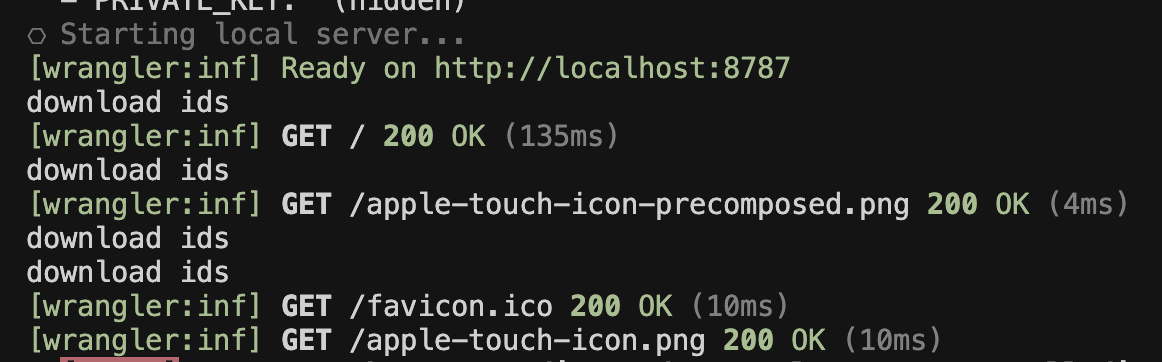 S
Sjust within the closure of the first step
SAHHH i am an idiot.. so because the web server is calling
fetch(req: Request, env: Env): Promise<Response> for the root, and the favicon requests that explains why each step is being called multiple times.
 C
Cnothing's failing, it's just the way workflow runs show in logs
Cteam said they working on fixing workflows
https://discord.com/channels/595317990191398933/1303411588929294358/1303488051917492318
https://discord.com/channels/595317990191398933/1303411588929294358/1303488051917492318
 S
S^ Does this mean there's an ongoing incident right now? Because some of my workflow invocations failed to call
await env.WORKFLOW_NAME.create() with an ambiguous "internal error", whereas some succeeded.S@Luís Duarte 
 Is there anything I can do to troubleshoot? We have certain invocations succeeding and others throwing
Is there anything I can do to troubleshoot? We have certain invocations succeeding and others throwing "Error: internal error" as far as I can tell. M
MWhen I start to get high traffic in an endpoint I'm starting to see errors above when trying to call a Workflow.
Seems to be something internal on CF side, the same code works fine when the traffic is "low"
And when I say high traffic, I'm saying something like 6 requests/s, in theory, this is supposed to be a low traffic on CF scale, right?
 A
AIs it possible to get the number of times a workflow step has retried? I'd like to call some code on the final retry to prevent future jobs from picking up the same item.
I know I could technically keep it in a variable outside of the step but I worry that context would be lost on retries. Any options?
I know I could technically keep it in a variable outside of the step but I worry that context would be lost on retries. Any options?
Kin workflow instance details page, output gets truncated for a particular "step history" which is a problem for me. i wonder if there is any plans to change this behavior?
 M
MI have a question the docs are not clear on:
Can I store the looped returned values? If so, how can I do so deterministically?
Can I store the looped returned values? If so, how can I do so deterministically?
 K
Kin the workflow rules page there was an example to that. the correct way was to use
Promise.allif i recall correctly.Mthat example is different though, it used a known number of steps (2 in the example)
Munless I can just slap this loop into a promise.all?
MI'm more experienced with Tasks in C# than promises
Kok i see your point. to store the returned items you need to do,
this should work
this should work
MI'll give it a try, thanks
MI'm facing a lot of
A call to blockConcurrencyWhile() in a Durable Object waited for too long. The call was canceled and the Durable Object was reset.
while seeing spikes on my file upload endpoint, and this is happening on something internal on my Workflows, and those errors seems to be not retriable, how fix this?
A call to blockConcurrencyWhile() in a Durable Object waited for too long. The call was canceled and the Durable Object was reset.
while seeing spikes on my file upload endpoint, and this is happening on something internal on my Workflows, and those errors seems to be not retriable, how fix this?
AI have some logic that returns from a Workflow
runrun C
CIt's just how they all show, team was working on a fix
workflows
https://discord.com/channels/595317990191398933/1303411588929294358/1303488051917492318
workflows
https://discord.com/channels/595317990191398933/1303411588929294358/1303488051917492318
 A
AAh thank you, good to know. That message being 6 months old doesn't give me a ton of confidence 
JYou can catch the error (meaning retries were exhausted), do whatever you need to do, then rethrow the error
 A
ACan I use a Tail Worker to handle logs from workflow steps?
AIt seems that the logs don't get send to the tail worker.
 A
AThe logs should be in the main worker that the workflow is attached to
D@alex (he/him) I have looked everywhere and can never find logs for any steps in a workflow. Maybe they are somewhere but I cant find them. This is single biggest weakness of workflows right now - logs are incredibly difficult to find for steps and this makes debugging them close to impossible. they should put the logs for each step on the actual step in the dashboard. This is what most other workflow platforms do - the logs for any workflow step are immediately visible in a UI for a step. i guess the only thing to do is send the logs to an outside service from each step, which make things complicated.
