Yepp... Lots of solutions... Though gears have backlash Reduction means less direct... And introducing play/elasticity Direct or pseudo direct needs more powerful motors and may need geometry corrections... may also have a bit of play in pseudo direct...
Lots of designs... But if car racing is anything to go by the direct appears to be the best of choices !
From what i've seen, rotational inertia seems to be fairly linearly correlated to rated torque produced in a motor (within a certain company's motor lineup at least). So, trading speed for inertia basically seems like a tradeoff of size/price vs system slop/elasticity.
But because force feedback you should be able to have negative software inertia and reduce this bad inertia effect. Also despite having more inertia, it will turn slower, meaning less acceleration and less inertia feedback. So result is actually similar. Plus... Actual flight controls usually have significant inertia !
I can't quite put my finger on the physical reason why right now but it seems to me that negative inertia would reduce system stability, did you notice this?
yes, the second sentence there was what I was trying to get at with the linear relationship between torque and inertia, It seems that the inertia/Nm will stay approximately the same with a reduction or without.
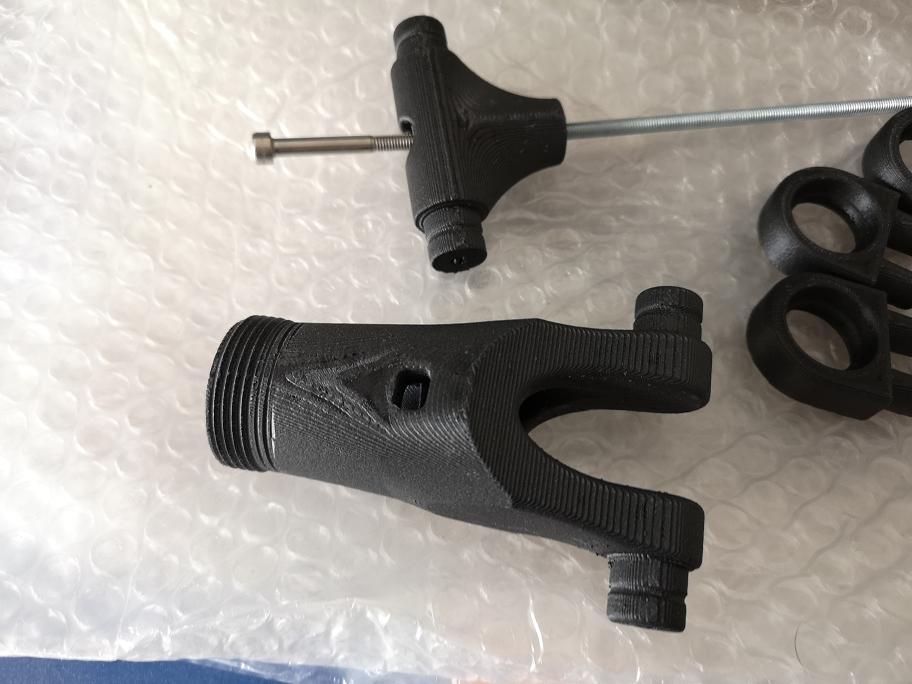
You can implement a simple grip with vpforce shift register board to add support for up to 32 buttons. The board will cost up to 10β¬. The grip attachement is M36x2 thread.
@pierre_lbThere's a gear design which is used in the primary drives ( crankshaft to clutch ) of modern motorcycle engines. Basically one of the gears is split into two halves, and the halves are biased using springs to be slightly out of alignment. That removes any backlash without having the gear train meshed so closely that it will destroy itself. It's difficult to explain, but obvious when you look at it. I've often thought the system would be good for driving transducers\rotary position sensors etc
Thanks, just wanted to check! Amazing work by the way. I started with the original thread by Propellor on the DCS forum, and have an assembled gimbal and chassis, just needed to sort the drive system and never got round to it. Much prefer they way you have done this though, great stuff.
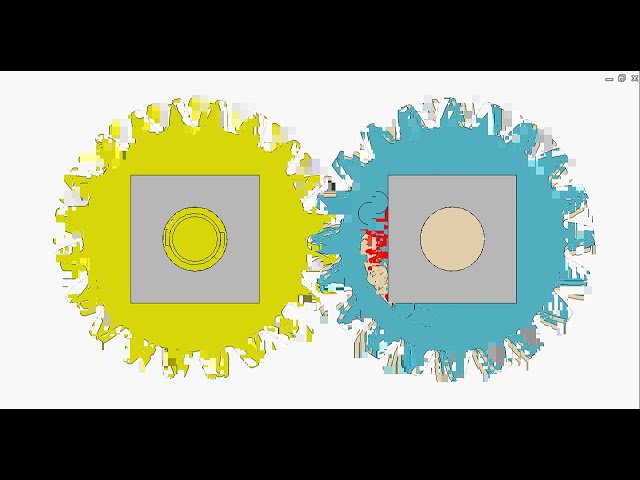
The blue gear is idly pivoted on the beige shaft. The red tension spring pulls the beige and blue gears, thus eliminating the tooth backlash between the yellow and beige gear shafts. The spring must be strong enough to maintain the tooth contact of the three gears. The third scene of the video shows how the backlash is eliminated under the sprin...
Has anyone done FFB anti-torque (rudder in helicopter) pedals? Does DCS support this? If so I'd like to order the Rhino plus a single motor kit to DIY my own FFB pedals. If it's possible, I'll post this in suggestions.
The pedals are doable, but directinput does not support third axis iirc. So sim telemetry data would be needed to be interpreted and developed to be sent to the ffb device.
You'll get some manner of feedback in light helicopters with simple cable/pushrod controls but there will only be artificial feel with irreversible hydro boosted controls. Usually through the form of a trimmable spring cartridge or simple friction.
Sorry to keep jumping in! Has anybody experimented with having two of these connected at once, before? e.g Is there scope to make one of the units mirror the other in a full two seat cockpit?
Ahh interesting! I'm building a full scale cockpit, replicating a Grob 109b motorglider, for a gliding club. Not much left to arrange, mostly controls now. It's a side by side seat config and syncing the sticks will be quite key. Any ideas when this might be possible?
Ahh nice. I have a functional gimbal, printed in Carbon PETG. It works nice, but at the extents of the control range, there is some binding and can't work out what it is!
The bearings to that bolt should have minimal play. If you have slop there you will have movement of the stick without gimbal rotation. Basically a dead zone. The parts twist slightly in relation to each other as you move through the control range. The center axis stays aligned but the pieces are rotated in relation and separated.
@walmis s @Vladinsky also: In most helicopters you have Force Trim or Magnetic Brake. Generally it affects both the cyclic stick and the anti-torque pedals. As Rage 204|Snake said, Basically you hold down the button, put the stick and pedals where you want them, then release the switch and it artificially sets the "spring center" of the stick and pedals to the positions they were in when you released the button. In some, especially older, aircraft like the UH-1H there is a toggle switch to completely disable the magnetic brake/force trim system but in many modern helicopters it's always on for safety even if the pilot doesn't want it as it reportedly significantly reduces the chances of a crash especially in IFR conditions etc. There is also incremental trim in many more modern helicopters but that is irrelevant to this particular inquiry as to my knowledge that only affects the cyclic. @Vladinsky DCS supports magnetic brake and force trim via standard force feedback like the MSFF2 which is what I have used in the past for this function. (It's been a few years so I've only tested on the UH-1H and Ka-50 but I assume the rest are supported as well. The Rhino uses the same built in force feedback support correct? So if it works with MSFF2 it will work with Rhino? Assuming that's a yes, the question really was just whether or not the pedals axis supports FFB in addition to pitch and roll FFB which if I understood @walmis correctly.. is not possible?
DCS does not support pedal ffb no, but it is possible to implement pedal trim using logic on the hardware side. And quite possibly ffb by exporting data from the game but that would be more complex and beyond me.