Hello everyone. I am Dr. Furkan Gözükara. PhD Computer Engineer. SECourses is a dedicated YouTube channel for the following topics : Tech, AI, News, Science, Robotics, Singularity, ComfyUI, SwarmUI, ML, Artificial Intelligence, Humanoid Robots, Wan 2.2, FLUX, Krea, Qwen Image, VLMs, Stable Diffusion
Good morning, I have a question about training multiple characters in a single LORA.
A few weeks ago, you mentioned that when captions are added to images (and these include the concept, for example, ohwx), the class token from the name of the directory where the images are stored is no longer used. That is, the 'ohwx' part of '20_ohwx' is not used, only the '20' is used to determine repetitions.
Based on this, if I want to train multiple characters, which strategy is better? a) One folder for each character, even if they all have captions. b) A single folder that encompasses all characters.
On another note, let's assume that for character1 I have 50 images and for character2 I have 100 images. Should this be taken into account in some way? For example, adjusting the repetitions so that the multiplication of repetition and number of images is similar across all datasets, or would this be counterproductive, and could it cause the dataset with fewer images and more repetitions to be overfitted compared to the rest?
Furkan, here? /opt/conda/lib/python3.10/site-packages/scipy/init.py:146: UserWarning: A NumPy version >=1.16.5 and <1.23.0 is required for this version of SciPy (detected version 1.24.3 warnings.warn(f"A NumPy version >={np_minversion} and <{np_maxversion}" /opt/conda/lib/python3.10/site-packages/scipy/init.py:146: UserWarning: A NumPy version >=1.16.5 and <1.23.0 is required for this version of SciPy (detected version 1.24.3 warnings.warn(f"A NumPy version >={np_minversion} and <{np_maxversion}" usage: sdxl_train.py [-h] [--v2] [--v_parameterization]
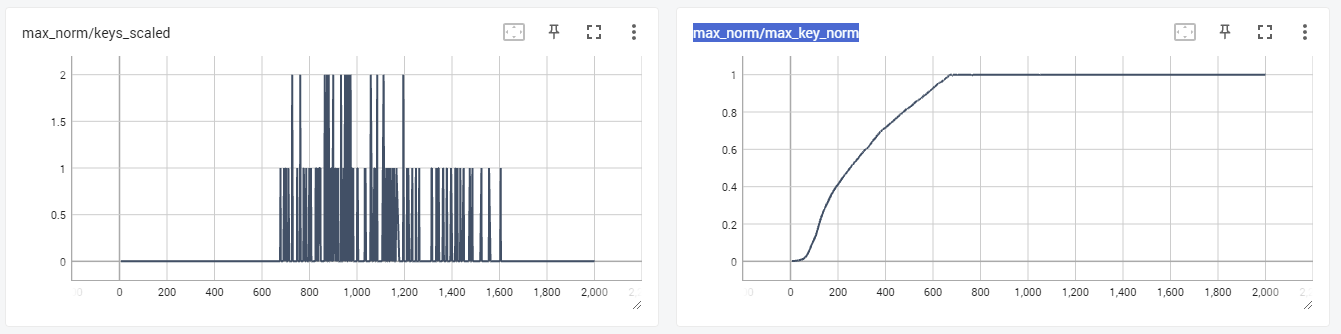
This is what a strong but flexible Lora graph looks like on Tensorboard. If a spike jumps out into the 3's that's borderline, but no more than 3's. So the goal is not to get max_norm/keys_scaled above 2. Plus a max_norm/max_key_norm should reach 1 before half of the training session, so you have time to normalize the model. So you can tell by looking at these values during training if the Lora will be good or not.
How much does the image set matter? 2 photos were duplicated, so my model may have been strong. After deleting these two and having only 23 photos left, I had to change the d_coef value, and 0.75 was too much. I went all the way down to 0.5, which seems to have been fine, although since it never reached the 1 limit of normalization, it was probably a bit under-trained. Based on the tests, not bad, but not reaching a score above 0.9, so really under-trained.
These graphs are only displayed when normalization is enabled for Lora (it is not enabled for DB). Based on the developer's description, I watch these two values to see if the maximum normalization reaches 1 (it is supposed to be good then) or not over normalizing, so how much it deviates from the original model, how much Lora needs to be improved. And from my observations, for cosine type training, these two graphs give very useful results under Prodigy.
This PR adds Dropout and Max Norm Regularization [Paper] to train_network.py Dropout randomly removes some weights/neurons from calculation on both the forward and backward passes, effectively trai...
That's what I was looking for in DreamBooth training, because it helps a lot to make a good model, and since I use it with cosine under Prodigy, I get absolutely good results when I watch the graph. I can see at a glance how good or bad Lora will be (see above), and tests have confirmed this.
Hi everyone, I'm having serious problem with dreambooth, I always get terrible results and for the good ones, the face is not the same per dataset. I'm training everything on epicPhotogasm.
Of course it's my fault, this is my setup (apart from the A100 80G): 20 pictures of the same person (always portrait shot, not fullbody) in 1024x1024 2000 train steps 100 class images lr 1e-6 100 validation steps (please let me know if you need more details on the settings, but everything else is set as default)
Do you suggest to use 100/200 pictures and increase both train steps and class images? Or if you have better suggestions I'm open to everything!
And here's the graph of the winning Lora, with d_coef=0.6 and 23 images. While I like to train it a bit stronger, I also let the Hires Fix work, which I used to boost the initial face to 0.96 for the very first generation. You can see in the image that I achieved normalization 1 on the right graph (yellow color), so it made a good model and only adjusted the normalization a few times.
RuntimeError: Error(s) in loading state_dict for UNet2DConditionModel: size mismatch for down_blocks.0.attentions.0.proj_in.weight: copying a param with shape torch.Size([320, 320]) from checkpoint, the shape in current model is torch.Size([320, 320, 1, 1]) my model: stable-diffusion-2-1-768v resolution = 768 can u help m? thanks
SDXL Turbo is a new text-to-image mode based on a novel distillation technique called Adversarial Diffusion Distillation (ADD), enabling the model to create image outputs in a single step and generate real-time text-to-image outputs while maintaining high sampling fidelity.
wondering whats an estimate fine tune training time i can expect for using Nvidia 2070 Super for training a face with 5200 512x512 regularisation images and 40 training images with 40 repeats. using RealisticVision5.1 is it normal for 1 epoch to take 7 hours according to my tqdm? im also already using AdamW8bit