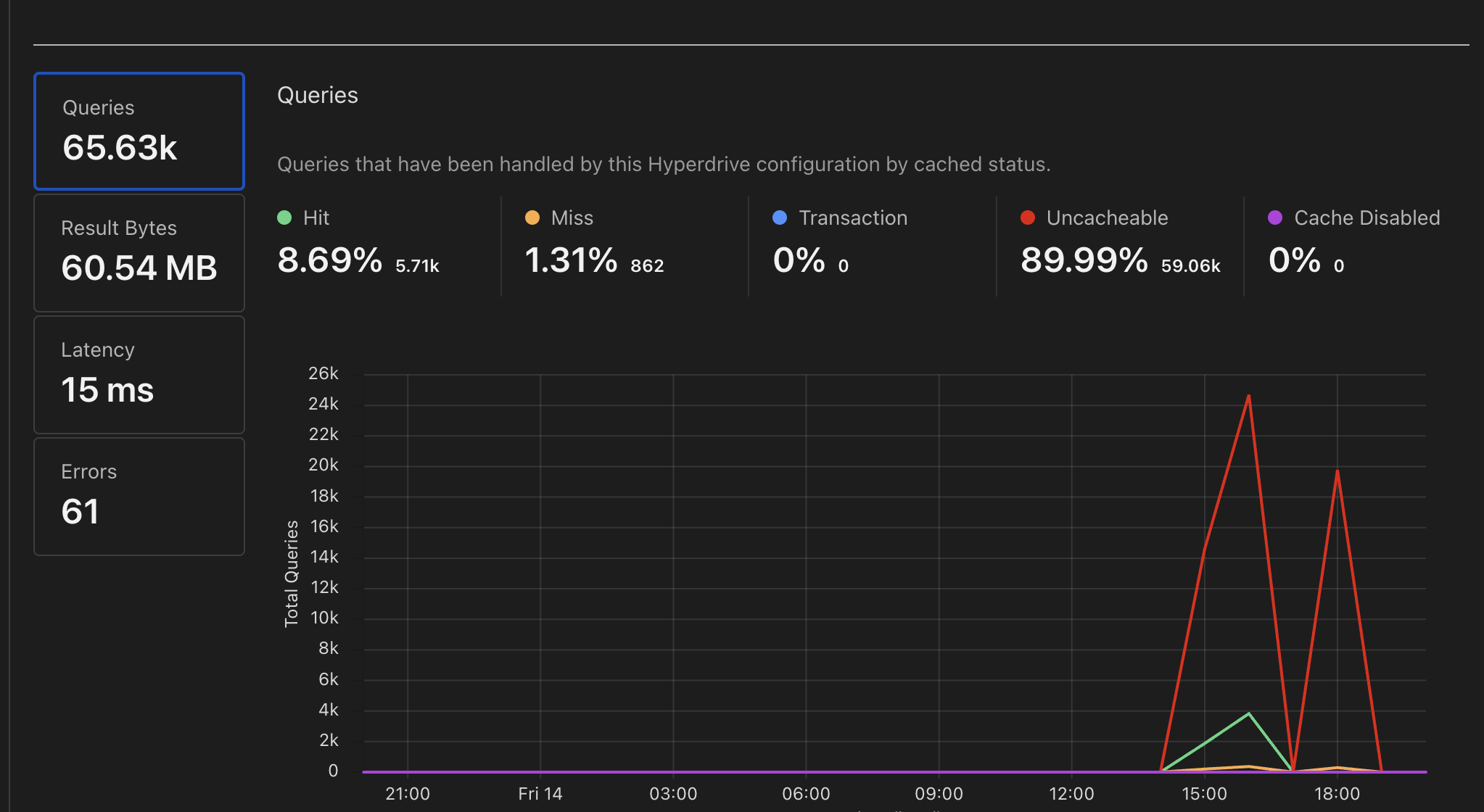
We were having connection issues to our Neon Postgres. It seemed like HyperDrive was the right solution for large scale due to it's strong pooling mechanism. That might be working correctly however it seems like fetching data via Hyperdrive is behaving differently
That is odd. That error is a type error from elsewhere in your code, but ultimately it shouldn't happen if your script had been working before and that's all you changed.
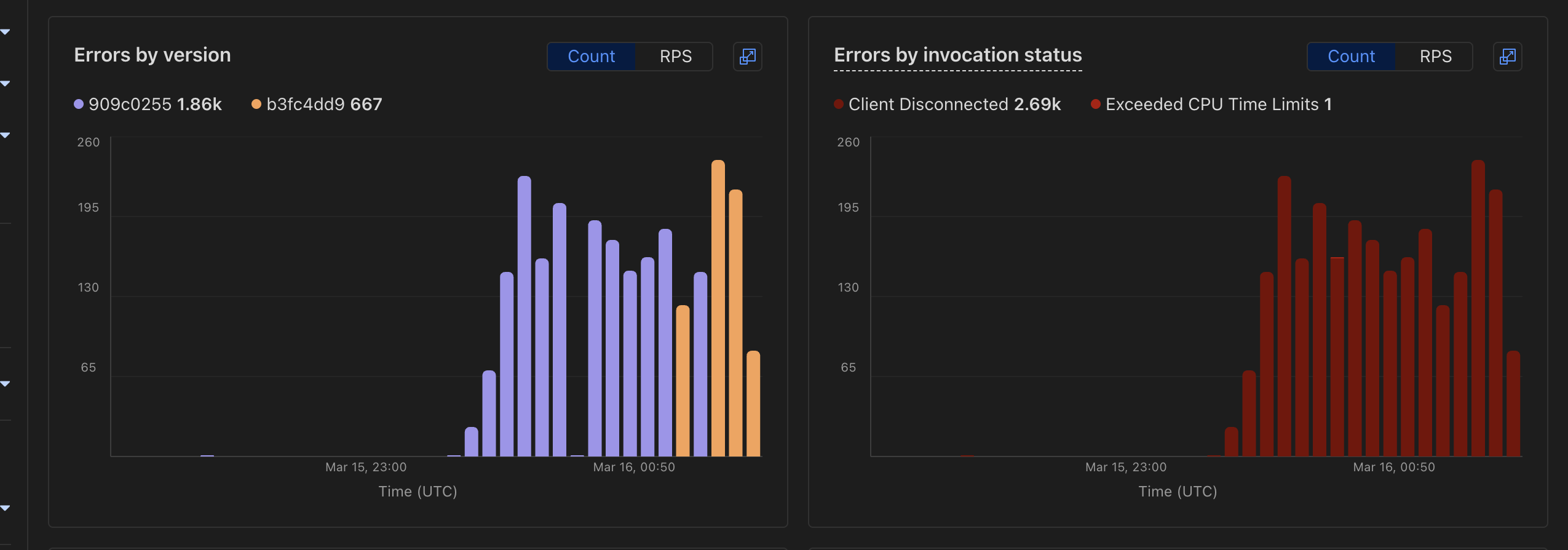
Hi, I'm not sure if Hyperdrive is the culprit here, but I'm seeing a huge spike in errors, and I don't see any logs in my dashboard so I can't really trace it down. I did see this happen when I was having issues with Hyperdrive, so I wanted to see if I could get a look please!
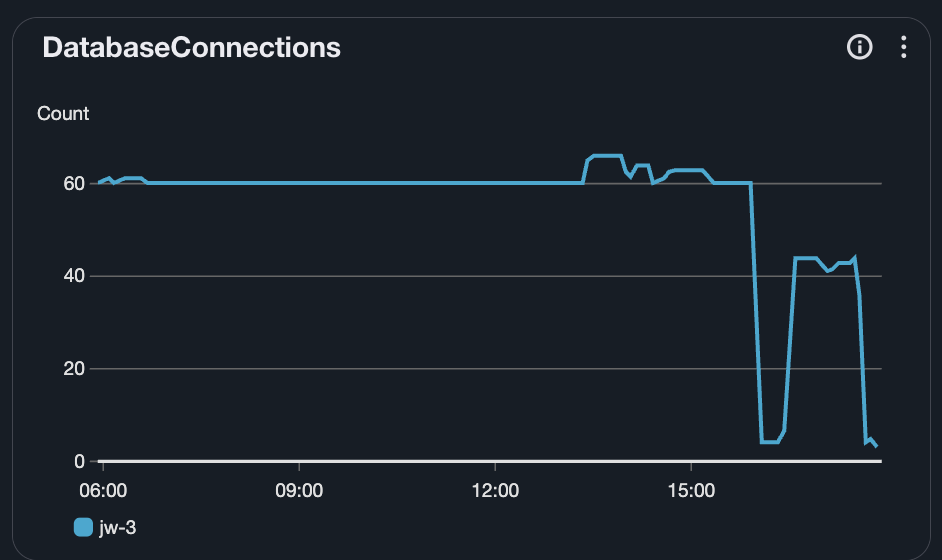
around the same time, i see that the number of DatabaseConnections I have in RDS gets really weird, which happened the last time I had a bunch of DB disconnects
I'm now fairly convinced that it was a Hyperdrive issue. As a hot-fix, I just deployed with a raw postgresjs client (no hyperdrive) and the errors stopped
I am afraid we were still having issues. I created a new Hyperdrive to the same db and it works fine. CORRECTION: the new hyperdrive worked fine at first, but then Client Disconnected errors started building up again
when things have settled, can you share more about what has been causing these client disconnected issues over the past couple weeks? i was considering moving to a privately accessible database with a Hyperdrive connection, but i can't justify the risk now because at least with a publicly accessible db, i can connect to it normally.
There's a few different things contributing to this, and picking apart which are the worst offenders requires some observability improvements that should have gone out today. I'll try to set aside some time this week to write up our plans on this topic.
Hyperdrive connects to external databases (e.g Neon, RDS, on-prem Postgres, etc), so it would depend where and how you're hosting the database you're trying to connect to.
D1 is a Cloudflare-native data storage product. It is a truly distributed product, and runs on our own network with our own tech stack. This means it will (usually) be more performant. However it does have some pretty sharp restrictions to its use, such as size or features, when compared to a more "standard" Postgres database.
Sometimes those restrictions will render D1 inappropriate for some use cases. In those cases, it would be nice to have the option to run your applications on a more standard Postgres offering either on-prem or from other vendors. In that case we still want people to be able to use Cloudflare's Developer Platform to build their application, so we built Hyperdrive. It is a tool for connecting from Workers to those other vendors' products. Because those are not on our network or our servers, connecting to them involves a network hop to wherever they're running. This means that Hyperdrive will often not be able to compete on raw latency alone. However, if you need some features that are not available on D1/R2/KV etc, now you have a way to access them.