A Study Community for Everyone and Everything. We have weekly sessions on Spirituality, Math and Science! JEE, NEET prep? All doubts are crowdsourced. Hare Krishna!
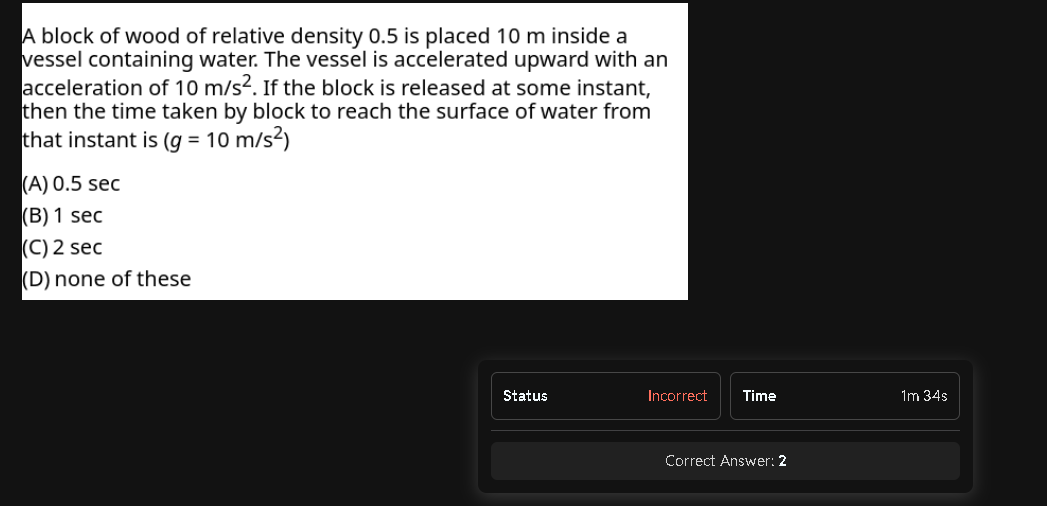
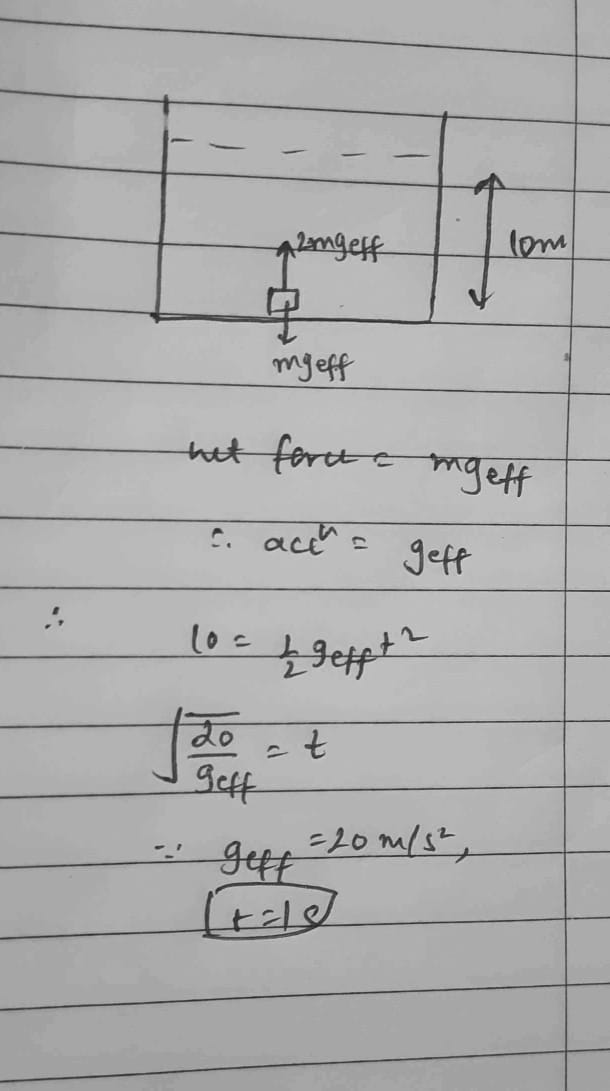
Initial position mein mg=Buoyancy, but when container is accelerated and block is released from the original position, there is an imbalance of pseudo force.
Vessel is accelerating upwards right? Now the pseudo-force on the block is downward, but there is also pseudo-force (downward) on the liquid, so the liquid exerts more buoyant force on the block. (Because now pressure gradient is higher with depth). So, the forces do not cancel out.
wait , psudeo force is downward on liquid , so it will become more dense , and because of more dense bouoynt force will increase thats why forces dont cancel , but how much denser will it become? cant say anything about that
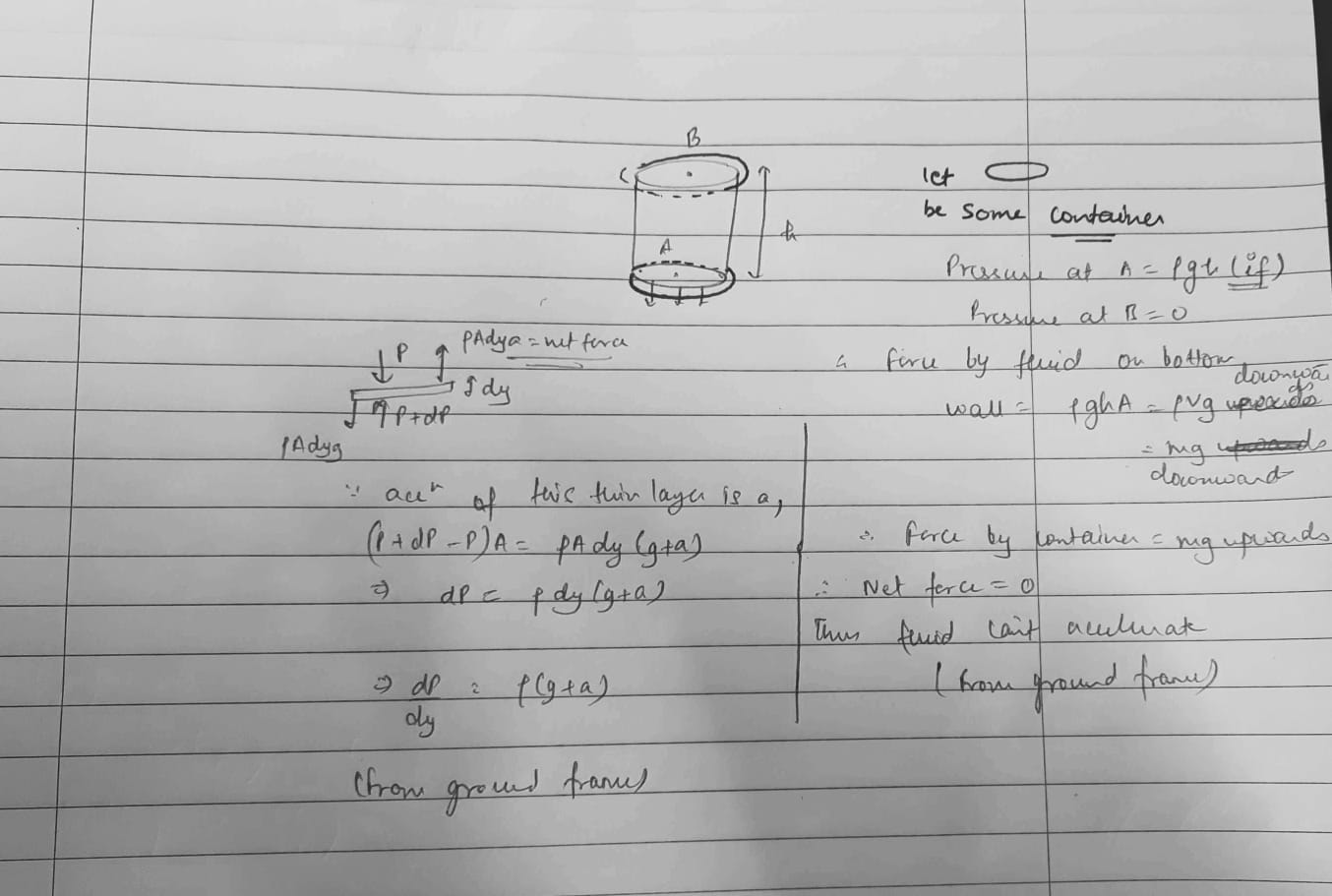
A rather correct way than saying "more dense" (since fluid is incompressible) would be the pressure gradient increases. As for by how much does it increase, consider a thin layer of width dy, then pressure dP on it would be rho.A.dy.(g+a)/A, so dP/dy=rho.(g+a) (where a is acceleration of the vessel)
Consider a cylinder. The pressure upwards on the bottom face is P(d+h)*A while that at the top is P(d).A (where P(x) is pressure at depth x, d is depth of top face and h, A are height and area of cylinder). So buoyant force is [P(d+h)-P(h)]A.
Well buoyancy is due to pressure difference at two points right? Now the pseudo-force increases the pressure exerted by each thin layer of fluid; so pressure increases more quickly as compared to the normal condition here. So pressure difference between 2 points with same vertical distance is more in this case as compared to the normal condition, hence buoyancy (which is due to pressure difference) increases in this case. This increased buoyancy is the answer to what you did not take into account here.
Well my counter argument is that lets take a point A it has lets say 0 pressure due to liquid i took base here , and pusedo force now point B at height H , it has pressure Rho G and puseodo force the psudeo force is same in both , so the pressure diffrence remains constant
Okay, Imagine a cylinder of height h from B to A. If you say the pressure at bottom is rho.g.h times higher than at B, the fluid experiences a force of rho.g.h.A in upwards direction (from ground frame, that is). This is balanced by the force of gravity so the cylinder should not have any motion in ground frame.
uid experiences a force of rho.g.h.A in upwards direction (from ground frame, that is). This is balanced by the force of gravity so the cylinder should not have any motion in ground frame. , i dont understand this part
This is from the ground frame. (The image) If we take inertial frame, then the explanation would be similar. (Pseudo-force in downward direction+weight of liquid) is balanced by extra pressure exerted on the fluid by the bottom layer.
ye mathematically i can see the result , but in the physical sense i still dont get it , like the pusedo force is Constant it will just get canceled out when taking change