
I don't think that works for the case of retry limits being reached
I don't think that works for the case of retry limits being reached
 KK
KK JK
JK i have an idea, i have been working with workflows and one thing that i keep thinking is how great it would be to have a tab called "Logs" inside workflow instance that displays
 console.log`
export abstract class AbstractWorkflow<T, R> extends WorkflowEntrypoint<Env, T> {
protected abstract getName(): string;
protected abstract validateInput(input: T): void;
protected abstract runStep(event: WorkflowEvent<T>, step: WorkflowStep): Promise<R>;
async run(event: WorkflowEvent<T>, step: WorkflowStep): Promise<unknown> {
console.log({
message: `${this.getName()} started.`,
level: "info",
event,
});
try {
this.validateInput(event.payload);
const output = await this.runStep(event, step);
console.log({
message: `${this.getName()} completed.`,
level: "info",
event,
output,
});
return output;
} catch (error) {
console.log({
message: `${this.getName()} failed.`,
level: "error",
event,
error,
});
throw error;
}
}
}
 A
A Already implemented some Kind of workaround on my own to get around those Limits, but currently I‘m just waiting for Container compatibility because it‘s solving so much additional Problems I‘m having with workflows right know IMHO
  KJJ
KJJ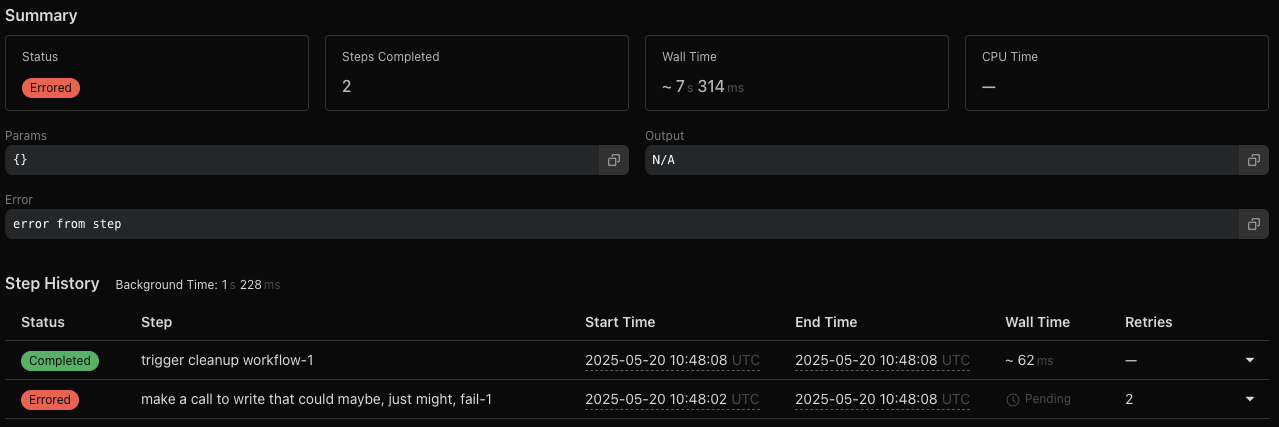
 B
BwaitForEventsendEventsendEventsendEventwaitForEventwaitForEvent CCC
CCC BC
BCworkflows-starter@0.0.1 deploy
wrangler deploy
 wrangler 4.16.0
 You are logged in with an OAuth Token, associated with the email xxx@gmail.com.
 Token Permissions: If scopes are missing, you may need to logout and re-login.
 Membership roles in "xxx@gmail.com's Account": Contact account super admin to change your permissions.
 S
Sdo something with ids SS
SS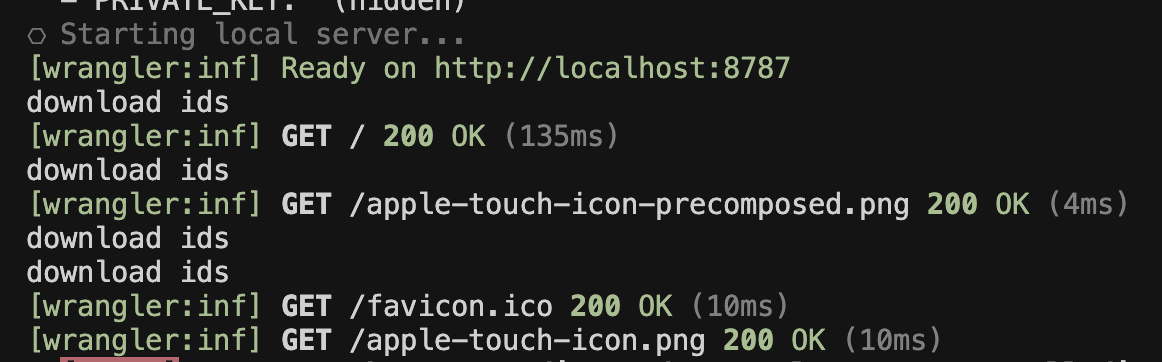 SS
SSfetch(req: Request, env: Env): Promise<Response> for the root, and the favicon requests that explains why each step is being called multiple times. CC
CC S
Sawait env.WORKFLOW_NAME.create() with an ambiguous "internal error", whereas some succeeded.S
 Is there anything I can do to troubleshoot? We have certain invocations succeeding and others throwing
 "Error: internal error" as far as I can tell. M
M AK
AK MK
MKPromise.allif i recall correctly.MM`
export abstract class AbstractWorkflow<T, R> extends WorkflowEntrypoint<Env, T> {
protected abstract getName(): string;
protected abstract validateInput(input: T): void;
protected abstract runStep(event: WorkflowEvent<T>, step: WorkflowStep): Promise<R>;
async run(event: WorkflowEvent<T>, step: WorkflowStep): Promise<unknown> {
console.log({
message: `${this.getName()} started.`,
level: "info",
event,
});
try {
this.validateInput(event.payload);
const output = await this.runStep(event, step);
console.log({
message: `${this.getName()} completed.`,
level: "info",
event,
output,
});
return output;
} catch (error) {
console.log({
message: `${this.getName()} failed.`,
level: "error",
event,
error,
});
throw error;
}
}
}
// src/workers/my.worker.ts

import { MyWorkflow } from "../workflows/my.workflow";

export {
   MyWorkflow
};


type Bindings = {
  MY_WORKFLOW: Workflow;
};

const app = new Hono<{ Bindings: Bindings }>();

app.post('/', async (c) => {
  return c.env.MY_WORKFLOW.create(..);
})

export default {
  fetch: app.fetch,
};export default {
async fetch(req: Request, env: Env): Promise<Response> {
let instance = await env.DATA_WORKFLOW.create();
return Response.json({
id: instance.id,
details: await instance.status(),
});
},
};async run(event: WorkflowEvent<Params>, step: WorkflowStep) {
const storageKey = `instructions-${event.instanceId}.json`;
const defaultConfig = {retries: { limit: 1, delay: 1000 }};
try {
const ids = await step.do('download ids', defaultConfig, async () => {
//
});
await step.do('do something with ids', defaultConfig, async () => {
//
});
await step.do('do something with ids', defaultConfig, async () => {
//
});
// Cleanup after successful completion
await this.env.TEMP_STORAGE.delete(storageKey);
} catch (error) {
// Cleanup on failure
await this.env.TEMP_STORAGE.delete(storageKey);
throw new NonRetryableError("Unknown error");
}
let workflow = await this.env.DATA_WORKFLOW.get(event.instanceId);
await workflow.terminate();
}fetch(req: Request, env: Env): Promise<Response>await env.WORKFLOW_NAME.create()"Error: internal error"[32mdetails:[0m { "request_id": "ae65c446-f13d-4f95-98b8-ed25ccfa47e6", "fileId": "a386a543-91f9-4a78-af85-257ee4ba2728", "error": "internal error", "stack": "Error: internal error\n at callFetcher (cloudflare-internal:workflows-api:24:15)\n at async WorkflowImpl.create (cloudflare-internal:workflows-api:78:24)\n at async fileUploadService (main.js:919559:11)\n at async fileUploadController (main.js:919663:32)\n at async dispatch (main.js:1116:21)\n at async main.js:859416:9\n at async dispatch (main.js:1116:21)\n at async main.js:859416:9\n at async dispatch (main.js:1116:21)\n at async main.js:967997:5" }",Promise.all// ✅ Good: steps that are dynamically named are constructed in a deterministic way.
// In this case, `catList` is a step output, which is stable, and `catList` is
// traversed in a deterministic fashion (no shuffles or random accesses) so,
// it's fine to dynamically name steps (e.g: create a step per list entry).
let catList = await step.do("get cat list from KV", async () => {
return await env.KV.get("cat-list");
});
for (const cat of catList) {
await step.do(`get cat: ${cat}`, async () => {
return await env.KV.get(cat);
});
}


