
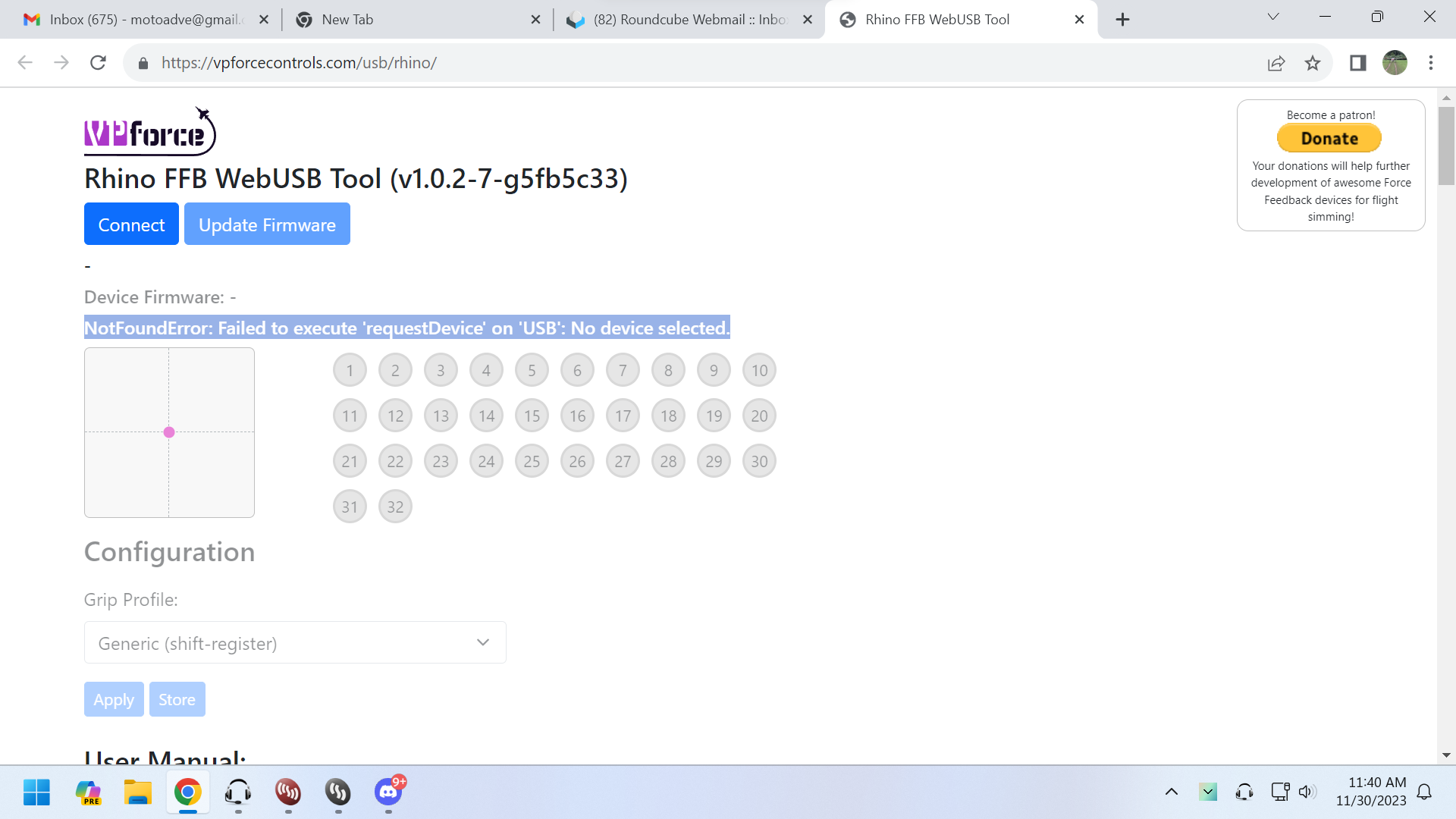
 I
INotFoundError: Failed to execute 'requestDevice' on 'USB': No device selected.

 N
Nthats the same error you would get if you didn't have a rhino plugged in at all. Are you sure windows is recognizing it?
IIts recognized, I plugged it and got a message to connect Rhino so it took me to the connect window
I I
IIt works now
IIn DCS I am not getting any effects except for stall buffet, what do I need to do to get the effects?
NTelemFFB is the telemetry app that enables all of the additional effects. DCS native implementation is limited to the dynamic stick forces and stall buffeting as you are experiencing. Head over to #VPforce-TelemFFB and download the latest from the pinned link. You can read up on TelemFFB in the manual linked in #VPforce Rhino WIP Manual 
 I
Iany way to have different VPForce configurations, let's say one for helicopters and another for jets?
Ialso what is it supposed to do the trim option in DCS, for helicopters, do we need to still enabling trim effect in VPForce effects? Thnaks
 N
Nyou can use the vpconf config setting inside the TelemFFB config to load any vpf configurator setup for a whole sim, aircraft category or specific aircraft, depending on where you put the setting in the config: 📃general
TelemFFB does not do anything special for helicopter trim in DCS. That is all handled by the native FFB implementation and the force-trim settings in DCS (for all modules you will want either the "instant" or "default" in their special settings, depending on the module).
TelemFFB does not do anything special for helicopter trim in DCS. That is all handled by the native FFB implementation and the force-trim settings in DCS (for all modules you will want either the "instant" or "default" in their special settings, depending on the module).
Ithank you
 I
II have this problem when I enable friction, if I disable it, it return to the strimmer center
 P
PIf you read the subsequent messages above, it turned out that I didn't have a config or hw issue. I simply misunderstood the intended behavior.
IPitch forces feel softer than roll , what setting do I need to change to make them equal?
IBu the way Telem FFB introduced a virus that has been a pain in the ass to remove.
II clicked on the FFB screen on the link on the bottom left corner and that inmediatelly started the virus
NThere is no virus in TelemFFB. Hundreds of people in here are running it. The source is open on GitHub too if you want to look at it.
Windows defender and some other AV tools will sometimes flag it as a virus however. This is because it is written in Python and compiled with ‘pyinstaller’ which can sometimes result in certain file hashes that are often found in low tech malware that is commonly also written in Python and compiled with pyinstaller.
Windows defender and some other AV tools will sometimes flag it as a virus however. This is because it is written in Python and compiled with ‘pyinstaller’ which can sometimes result in certain file hashes that are often found in low tech malware that is commonly also written in Python and compiled with pyinstaller.

 R
R@walmis after getting my adpater in place yesterday I've only now got around to testing it and I'm unable to get my WinWing F18 stick buttons working. Firmware is v1.0.16 - any suggestions?
RNot a single WinWing button is highlighting when clicked in...
1) Microsoft game controllers (which I realise I should ignore anyway)
2) The WebUSB tool
3) The RAW BTN column in the VPforce Configurator
I have grip type selected as "WinWing Adapter" but I've tried all the others as well (just to test) and nothing is working
1) Microsoft game controllers (which I realise I should ignore anyway)
2) The WebUSB tool
3) The RAW BTN column in the VPforce Configurator
I have grip type selected as "WinWing Adapter" but I've tried all the others as well (just to test) and nothing is working
 R
RLegobirds - do you get yours working?

 W
WSomething is not mating properly most likely, let's see which side is not talking:
1: set Generic grip debug
1: set Generic grip debug
- Open Debug Tab and check the data that it's printing
 W
WIf the data is all FFs then the adapter is not talking to the base
R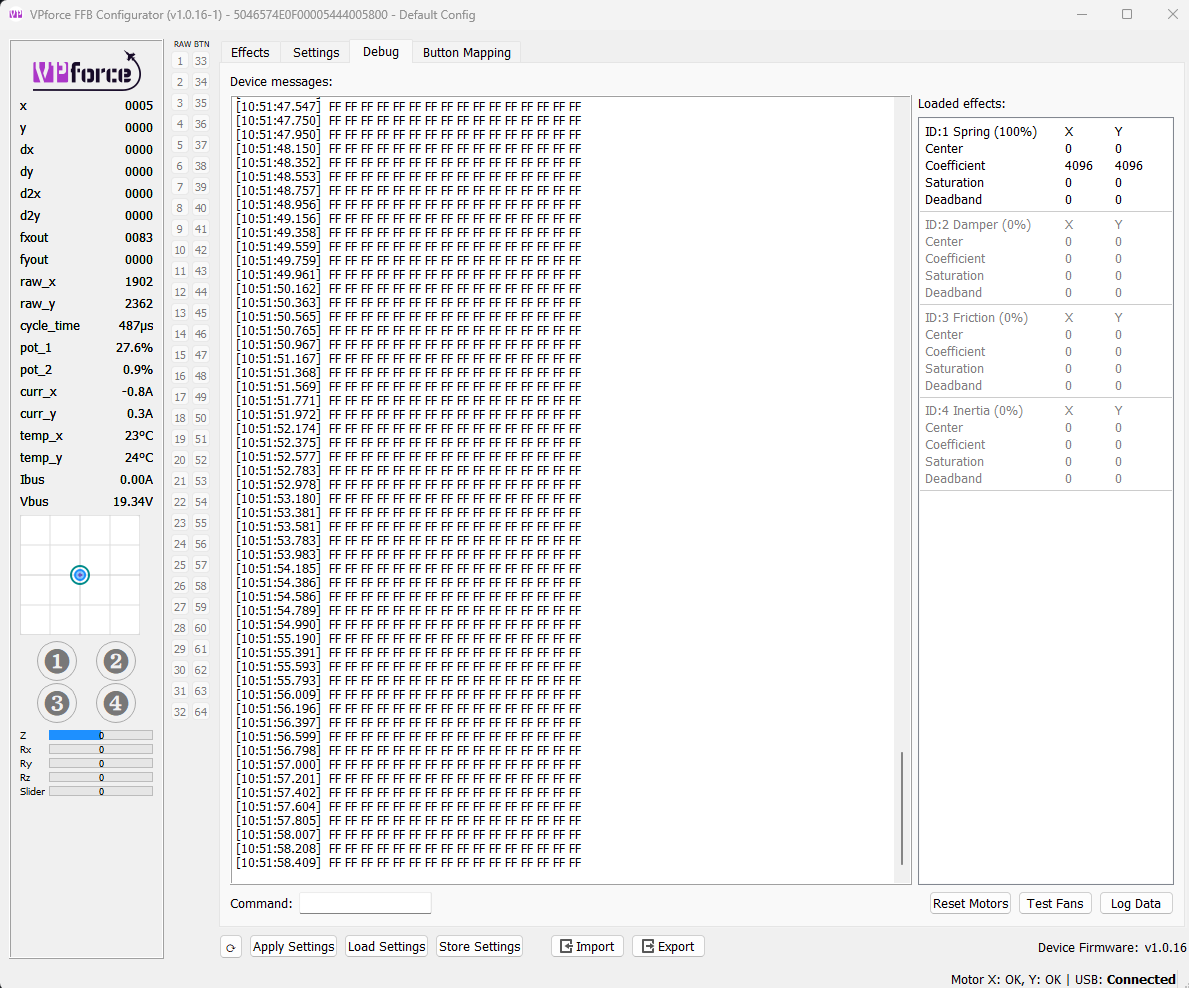 R
Rlooks like that's the case then
Wmaybe it's not inserted properly, the star pattern should insert fully into the base
Ri'll double check
Rshould it "work" without the joystick head attached?
Wyeah
WI recommend holding it like this and plugging it into the socket
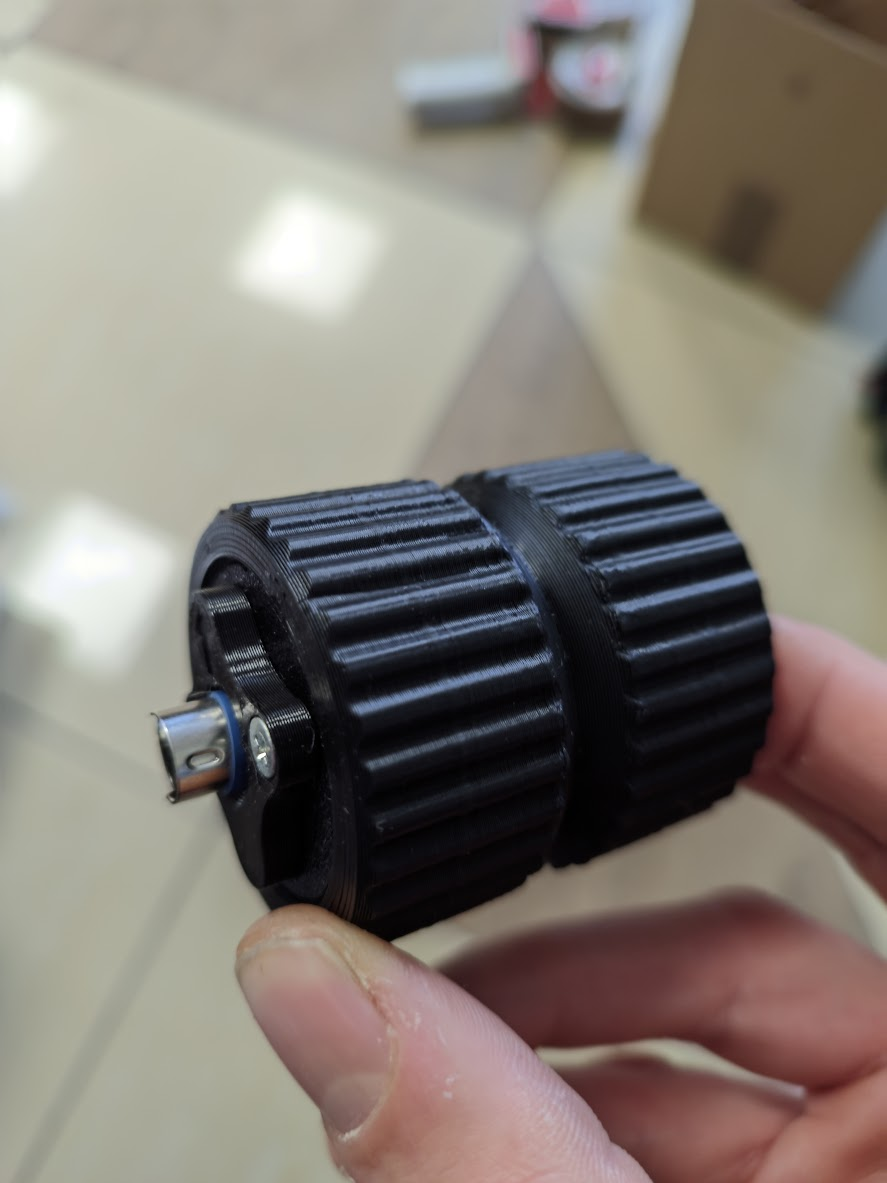 R
Rok, I've tried a couple of times and I'm pretty confident i've got it fully in place - but still reporting back all FFF
Wd'oh, before I send you a new one, can you remove bottom start piece from the adapter and check?
Ryeah, just did that as well - figured it might be blocking it going in all the way or something - no luck 
WNot sure what went wrong there, since I've tested it before shipping without issues
Rhum, rember this was the one I sent the picture of that showed the misalignmed of the bottom start piece... so not sure if this one COULD be tested in it's final form (at least not how it arrived to me?)
RI can solder fairly well... any chance I could fix it rather than you sending out a new one or is there a circuit board in there?
Ror if you DID test the adapter is there any chance it could be a problem with the base?  any way I can check that?
any way I can check that?WDid it come out of the box like that? Or you noticed after you tried to attach it? Maybe it got mixed up with an untested one, hmm.
Ryeah, 100% came out of the red bubble wrap packet like that
Rnope, was never able to attach it - I know how fragile these connectors are so checked visually first
WRoger that
WI'll probably arrange you a new one
WYou can try to fix the existing one in the meantime
Rok amazing thank you - and yeah, I'll try and give it a look this weekend - if I get it working I'll let you know as soon as I can 
RYeah even like this I’m getting FFF
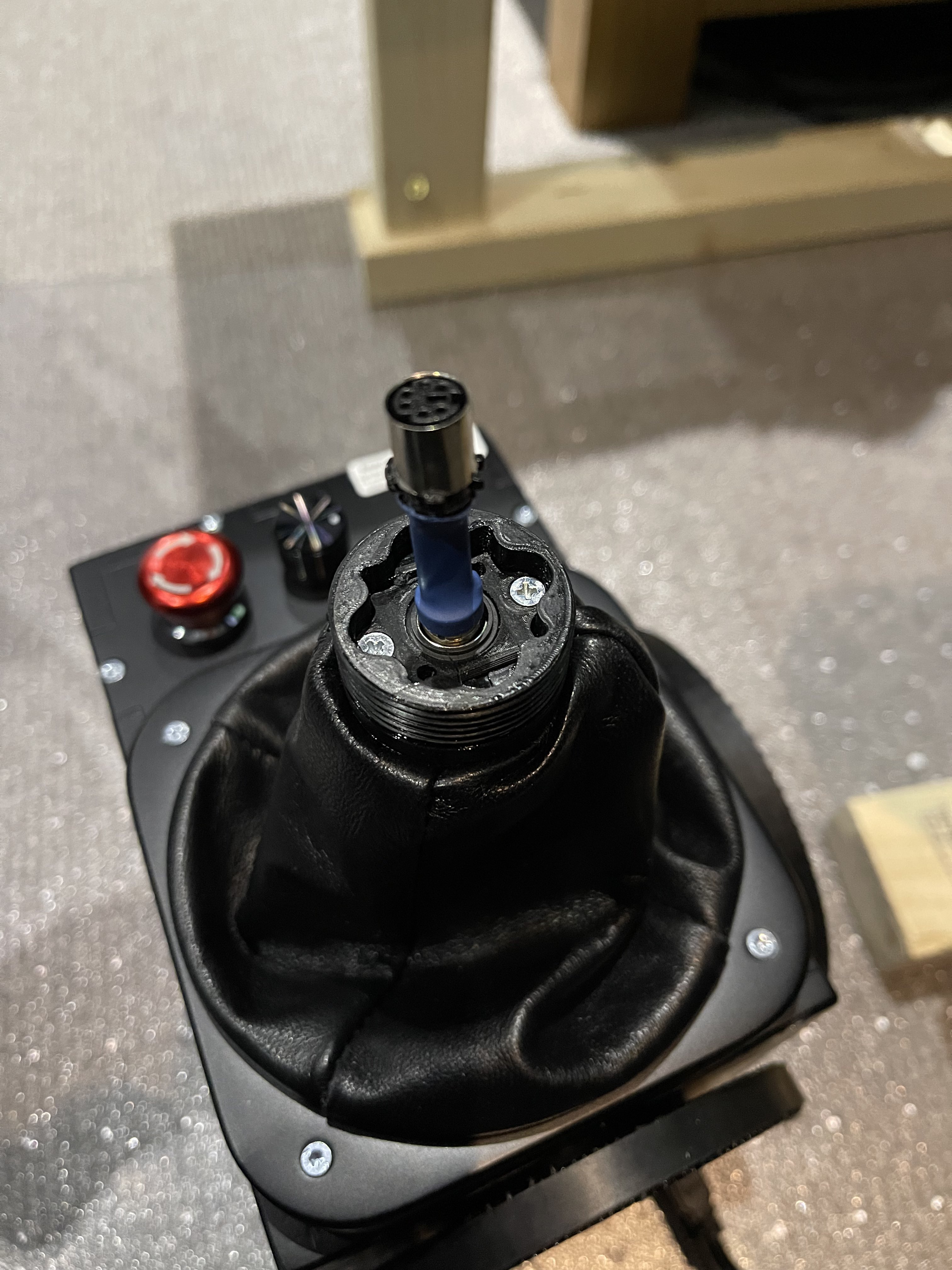 W
WYou can test the internal connections by probing with a multimeter in diode test mode: put the positive(red) probe on GND go through other pins with the negative(black) one. It should read a diode (~0.5-0.7V) on all pins, otherwise it would indicate a broken internal connection.
 R
Rha, well, only the VDD is reporting 0.62V - all the other ones don't seem to register at all - not even 0.0V
Rand ehhh yeah... no obvious soldering problems so I don't think I'm going to be able to fix it myself - wouldn't have guessed there was a whole circuit board in there! 
 I
II downloaded the latest WIP from Nov 30th, it worked fine, the program did not install a virus.
There is a link in the window that says get help.
Virus got installed when I clicked on it.
There is a link in the window that says get help.
Virus got installed when I clicked on it.
IWhat it does it opens browsers in all of them with get help pages non stop.
IThat get help link its on the lower left hand corner.