
Something like this ```typescript const defaultPayload = { hits: 1, expiration: new Date(new Dat
Something like this

const defaultPayload = {
  hits: 1,
  expiration: new Date(new Date().getTime() + 60_000),
}

const record = await env.NAMESPACE.get('key', { type: 'json' })

const payload = {
  ...defaultPayload,
  ...(record ?? {}), // if record is nullish, spread an empty object in its place
}

await env.NAMESPACE.put('key', payload, { expiration: payload.expiration }) AAA
AAAWorkerKVhono which uses expirationexpirationTtl? I
I A
A I
I A
AWorkerKVresetTime if there's already an expirationexpirationget('key') it returns an object with the expirationexpirationlimit. so not very many.Iput(); you fire and foget them until the next request where you list()expiration IIA
IIAWorkerKVDurableObjectsIIAIIKV is not really a good idea here due to it’s eventually consistent nature. You can however make a rate-limit from Durable Objects 272, which some others have already made from too.
A V
V X
X
 B
B I
I H
H V
V R
Rnpx wrangler pages deploy is erroring for me, Cloudflare having API issues? C
C A
A WA
WA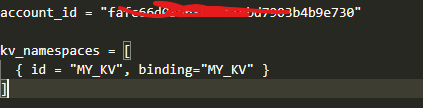
 D
Dwrangler secret put INNGEST_SIGNING_KEY doesn't make it available in the "environment variables", inngest sync fails and to put it in environment variables, I need to add it to wrangler.toml as "plain text" and deploy.WA SA
SAhonoexpirationTtlresetTimeget('key')limitput()DurableObjectsnpx wrangler pages deploy ✘ [ERROR] Received a malformed response from the API
upstream connect error or disconnect/reset before headers. retried and the latest reset reason: conn... (length = 114)
GET /accounts/***/pages/projects/example -> 503 Service Unavailable✘ [ERROR] More than one account available but unable to select one in non-interactive mode.
Please set the appropriate `account_id` in your `wrangler.toml` file.
Available accounts are (`<name>`: `<account_id>`):wrangler secret put INNGEST_SIGNING_KEYPS D:\others\durable-objects-template> wrangler dev
⛅️ wrangler 3.63.1
-------------------
Your worker has access to the following bindings:
- Durable Objects:
- COUNTER: Counter
⎔ Starting local server...
╭─────────────────────────────────────────────────────────────────────────────────────────────────────────────────────╮
│ [b] open a browser, [d] open Devtools, [l] turn off local mode, [c] clear console, [x] to exit
╰─────────────────────────────────────────────────────────────────────────────────────────────────────────────────────╯
C:\Users\user\AppData\Roaming\npm\node_modules\wrangler\wrangler-dist\cli.js:29765
throw a;
^
MiniflareCoreError [ERR_RUNTIME_FAILURE]: The Workers runtime failed to start. There is likely additional logging output above.
at #assembleAndUpdateConfig (C:\Users\user\AppData\Roaming\npm\node_modules\wrangler\node_modules\miniflare\dist\src\index.js:9178:13)
at process.processTicksAndRejections (node:internal/process/task_queues:95:5)
at async Mutex.runWith (C:\Users\user\AppData\Roaming\npm\node_modules\wrangler\node_modules\miniflare\dist\src\index.js:3521:16) {
code: 'ERR_RUNTIME_FAILURE',
cause: undefined
}
Node.js v20.14.0async increment(key: string): Promise<ClientRateLimitInfo> {
const keyWithPrefix = this.prefixKey(key);
const defaultPayload = {
totalHits: 1,
resetTime: new Date(Date.now() + this.windowMs),
}
// @ts-ignore
const record: Required<ClientRateLimitInfo> | null = await this.namespace.get<Required<ClientRateLimitInfo>>(
keyWithPrefix,
"json",
);
const payload = { ...defaultPayload, ...(record ? { totalHits: record.totalHits + 1, resetTime: new Date(record.resetTime) } : {}) }
console.log("Payload - ", payload, " Expire - ", payload.resetTime.toLocaleString(), " Current - ", new Date().toLocaleString())
await this.namespace.put(keyWithPrefix, JSON.stringify(payload), {
expirationTtl: !record ? payload.resetTime.getTime() / 1000 : undefined,
});
return payload;
}


