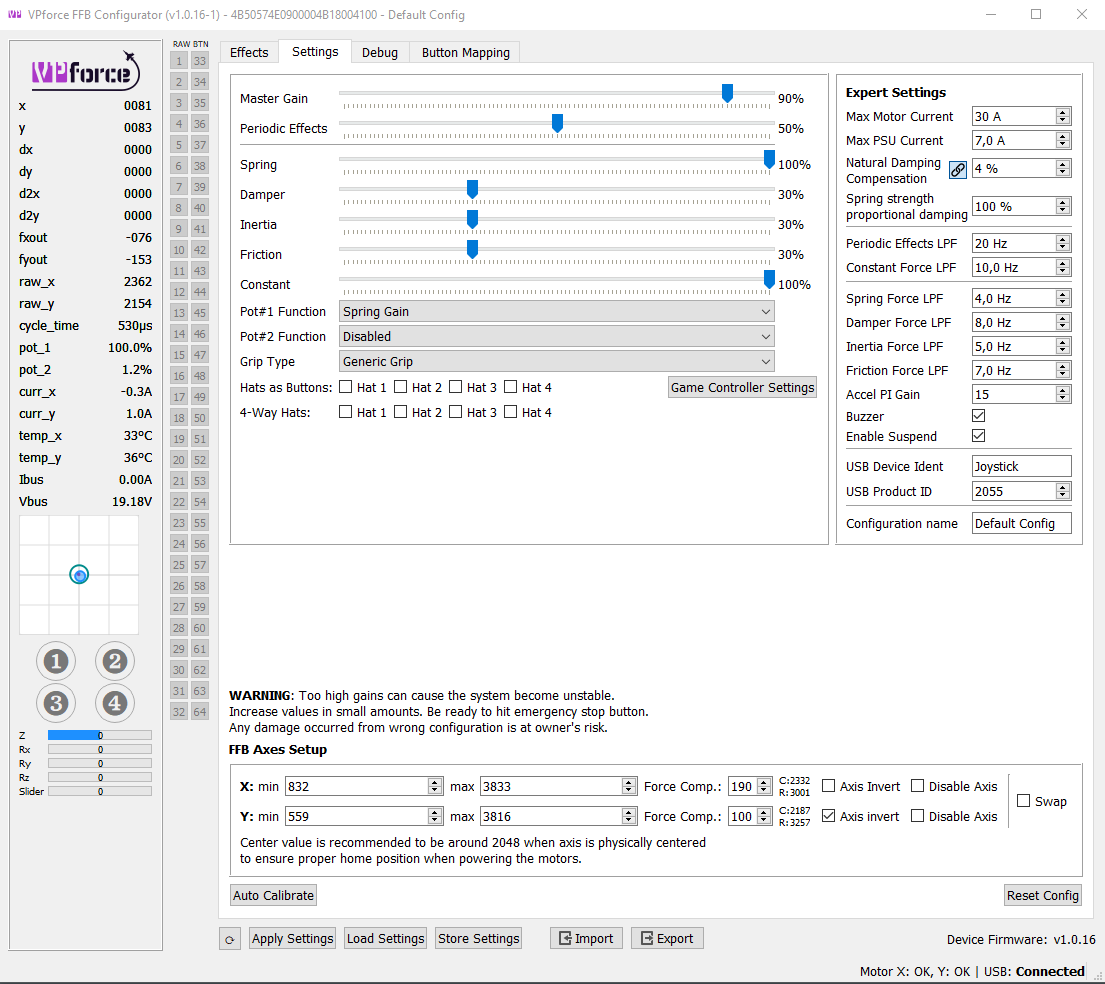
Everything else feels normal? No grinding, no cracking noises etc. ? Canβt think of a reason why only one certain effect could cause issuesβ¦.. Checked the settings? (in config and telem!)
Telemffb needs an Config file to use the settings.... In the Settings Page I selected a standard profile that should be loaded at startup.... But.... When starting the sim, the stick is passiv... only acts like a spring / Damper.... If I select / load the same profile in the planes dialog the stick comes alive... why?
I don't fully understand what you are asking. You don't say the sim, but I'll assume DCS.
Taking TelemFFB out of the equation here (all it's doing is pushing a saved profile to the joystick)....
DCS "takes over" the spring effect during startup, this is why your stick goes limp when the sim is loading. It takes ownership of the spring effect and sets the gain to 0.
When you load into an aircraft, the FFB implementation for that aircraft will set the gain of the effect to whatever it should be based on the phase of flight you load into.
When you exit back out to the main menu, the stick generally goes back to a springless state.
Hi, I am looking for a X-Plane/MSFS airplane, where the autopilot following works well. So far, I am always having increasing oscillation issues. I want to turn on the ALT or HDG knob and see the magic. Does this work for any of you? On which plane?
Hard to say without knowing the exact process you are following and when it is changing (you can watch the configurator slider to see exactly when it changes). However...
Today, TelemFFB attempts to leave the gains in exactly the same state in which it found it when it was started. Upon startup, the gains are read from the base. When you exit TelemFFB, it reapplies those gains. This means that if you start TelemFFB with a slider set at %50, then realize you want it at %100 and change it manually, TelemFFB will set it back to %50 when it exits.
In the next version, this functionality will be placed behind a system setting rather than being the default behavior. It can be useful, but can lead to confusing results if you don't know its happening.
This should be raised with the IL2 devs. IL2 has native FFB, meaning the spring forces are generated by the sim. A given FFB base just "does what its told" in this regard.
I took my rhino apart some and am reassembling now. I did not realize the pulley gears had a couple longer screws. Does anyone know which spot the longer screws go?
What do you mean? The long screws attach the belt pulley to the gimbal. 5 or 6 each iirc. These are the longest screws in the rhino I can think of - and they can't go anywhere else. I have a DIY rhino though.
As walmis mentioned, the long screws go on the base of the gimbal frame. Just remember that one of the bases faces the floor and the other faces the top.
normally e-stop (red button) toward pilot... but its literally 3 clicks in the configurator software to invert the axes, so install it whichever way makes the best geometry for your setup
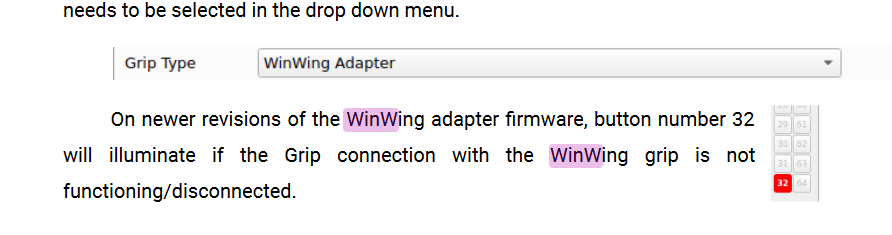
Doubt thats it. I really used some force to make sure its properly connected with and without screwing it. But I think the issue is between the adapter and the base cause I just got it today and according to the manual the newer versions should show bad connections between the stick by turning on input 32 which is off
youβre right that the 32 indicates poor connection, not a failed stickβ¦..mine would register the correct buttons only on firmly pressing in the stick plug to adaptor. Sounds like your issue isnβt that though