

 N
Nwhat's your grip? Clamp only works for non twist MCGs and extensions, no clearance otherwise
 L
LI guess simautica actually developed a webstore
@=RS= ddrake1984 willing to bite the bullet, I don't think any one has even evaluated these yet
https://www.simnautica.com/product-page/ga-forcefeedback-rudder-pedals
@=RS= ddrake1984 willing to bite the bullet, I don't think any one has even evaluated these yet
https://www.simnautica.com/product-page/ga-forcefeedback-rudder-pedals
Simnautica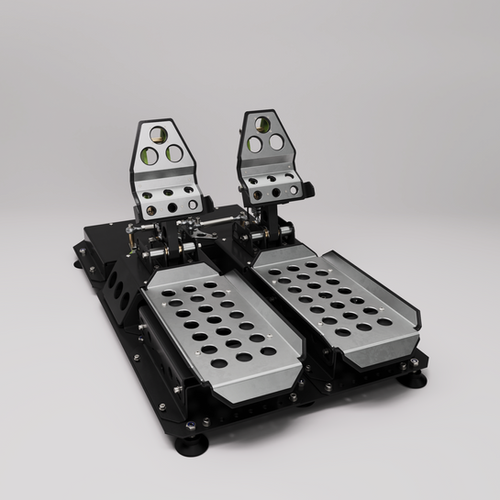
Elevate your flight simulation with our high-performance GA Rudder Pedals. Key features include: Realistic Force Feedback: Powerful BLDC motor delivers up to 20KG of force for unparalleled immersion. All-Metal Construction: Built for durability and precision. Adjustable Pedal Distance: Customize for the perfect fit. Load Cell Toe Brakes: Sensiti...
L99% sure it’s based off FFBeast
 D
Dlooks really nice, not sure how your feet are gonna slide tho
LYeah someone will have to be the guinea pig to figure out how it actually works. Would be good if they had a demo video somewhere of it being used
 H
HLooks a bit narrow to me. Quite the opposite of the MFGs which are on the wide side.

 S
SCheck the page, they adjust WIDE
 S
SIt looks like they're based on the Cessna 150 style pedals, where most of the input comes from flexing at the ankle and pivoting on your heel. For full travel you'd pick up the heel and push with your whole leg

 T
TSame as most of the trainers and small (single) engine.
The Piper Cherokee I got my license on (1994) is the same way with different pedals and a wider stance (closer to MFG stance which is honestly closer to the fighters with a tunnel as well)
Close together pedals are mostly on helicopters honestly
The Piper Cherokee I got my license on (1994) is the same way with different pedals and a wider stance (closer to MFG stance which is honestly closer to the fighters with a tunnel as well)
Close together pedals are mostly on helicopters honestly
 P
PCan Hippo implement Gear Lock for H shifter?
Pif it does I will sell my 900euro H shifter
Pand I can side mount it
SYeah exactly. C150 is tiny. I was the smallest person at my school and even I had trouble getting full control throw.
 M
MHey guys 
Does the Rhino work with Warthunder? It should work as a standard joystick but I want to know if warthunder has FFB that the rhino can use
Does the Rhino work with Warthunder? It should work as a standard joystick but I want to know if warthunder has FFB that the rhino can use
 F
FNope
FI couldn't get any spring force at WT
 W
WIt's a sad day, had to cancel my preorder because money became a factor. Maybe next year then or I will go the DIY route at the end of the year.
 B
BI feel yah, was fortunate my number came up when it did.
 H
Hmaking it sticky in the software didn’t help?

 P
Poo those are pretty. Maybe if someone buys them they'll have a unit actually built and can take a real product photograph
LYeah if you make the forces sticky it will “work” the only effects you get from the game though are vibrations. Moza has claimed they are working with War Thunder on FFB, and Star Citizen for that matter, but they make many claims
 L
LThe simnautica instagram has pictures but they don’t show them in action, it’s all about the sticks https://www.instagram.com/simnautica/reels/
1,551 Followers, 804 Following, 38 Posts - See Instagram photos and videos from Simnautica flightsim hardware (@simnautica)

 S
Shi,
about propeller aircraft, how to render the fact that the faster the plane goes, the "harder" the stick ? in DCS
about propeller aircraft, how to render the fact that the faster the plane goes, the "harder" the stick ? in DCS

 A
AIn any aircraft with mechanical controls
Syes
Sis it a way to link IAS/TAS to Dynamic Spring ?
 P
PIt will work as long as warthunder supports telemetry output.
PI think Warthunder Does
Pjust ask wall miss to add support warthunder
PI am not sure but It will work if you set telemetry output port to teleffb with il2 setting ? if teleffb detects exe file it will not work but just try.
LThis goes into the issue with the other bases coming out, looks like the simnautica pedal will not have a lot of effects. I suppose with pedals it isn't as much of an issue, but if you look at the work in TelemFFB even for something as niche as pedals there is substantially more telemetry read.
 L
LI’m pretty sure TelemFFB incorporated stall effect on some planes in DCS at least on the pedals as it reads data.
This I’m not even sure it’s able to do that. Would be a big gap even if you’re not trying to go full realism.
This I’m not even sure it’s able to do that. Would be a big gap even if you’re not trying to go full realism.
HIn TelemFFB all the effects (stall shudder, engine rumble, gun and so one are simply output on the pedals, the same way they would be put out on the stick. Which works great imho.
SHi,
same question with other words ...
On DCS, what parameters or settings should be applied with a plane with mechanical controls (Fw190-D9, Fw190-A8, Bf109-K4, Spitfire MK-IX, P-51D) so that the joystick is completely free with the engine stopped and then the resistance (spring) increases according to the engine power and obviously the speed?
(.lua, TelemFFB, ...?)
same question with other words ...
On DCS, what parameters or settings should be applied with a plane with mechanical controls (Fw190-D9, Fw190-A8, Bf109-K4, Spitfire MK-IX, P-51D) so that the joystick is completely free with the engine stopped and then the resistance (spring) increases according to the engine power and obviously the speed?
(.lua, TelemFFB, ...?)
 A
Adon't most DCS prop planes do that by default?
 S
S... sorry don't understand your answer...
HHe meant, that with most prop aircraft you don’t need to tune anything to do that. They domthat by default. (Maybe you can tune the strength and onset with telemFFB, but generally that is a build in feature)
Swell, without TelemFFB, the only way the stick strength up is when AOA goes up, but not depending on speed
Swith TelemFFB same thing as i only see AOA as monitor effect
Sif someone experiment this behavior correctly can you please share your settings ?
 1
1Has anyone mounted their rhino in a Sim fab pit? I’m about to order a DIY kit and was curious about the mounting solution as this is much larger than my VPC CM3 with a 200mm extension.
 O
OI also have a VPC on 200, interested
 A
AI didn’t change or tune any settings, and for the spitfire, p51, and p47, the stick is dead when parked, and as I accelerate on take off, it stiffens up. Not sure if this is what you’re referring to or not
 B
Bairspeed should have a huge impact on control forces. at slow speed, controls generally feel mushy and unresponsive with hardly any centering force while high speed can make the stick almost impossible to move with human strengh.
afaik, dcs does some axis scaling to simulate the maximum force a human could produce, but i dont like the way this interferes with FFB. (source here is the DCS forum, i dont know for sure how they implemented this)
if somebody knows more about this and if there is a workaround, id like to know
afaik, dcs does some axis scaling to simulate the maximum force a human could produce, but i dont like the way this interferes with FFB. (source here is the DCS forum, i dont know for sure how they implemented this)
if somebody knows more about this and if there is a workaround, id like to know
 N
NForget about TelemFFB here. It has nothing to do with dynamic spring forces in DCS. That is completely handled by the native FFB implementation in each DCS module, which is something we have zero control over.
The spring effect gain values in VPforce Configurator will dictate the actual felt forces at any sim commanded "force coefficient", but we can't control how the sim tells the joystick to apply the forces.
The spring effect gain values in VPforce Configurator will dictate the actual felt forces at any sim commanded "force coefficient", but we can't control how the sim tells the joystick to apply the forces.
SOk, thank you for your reply (Hiob, amadeus, Broko and Number481) my settings was too low, i set almost 100% on Spring, Master, etc, and effectively i have this kind of behavior.
PAre there anybody who tried moza ab9 in Fsexpo?
PI preordered it but I am not sure whether it is good or not
 J
JReviews should start coming out soon, they are stating a software update is coming on the 15th (tomorrow) and asked to not review till after that.
 1
1i decided not to order it because it doesnt have a "force trim interrupt" i fly mainly helos so its useless to me so i decided to go with a rhino diy!