

 R
Ri really want to try to believe that but i can't
Rthere's no way. this process is so cumbersome
Rand then it bugs out on you
 A
Ai plugged the device in, went to the website, did the beta upgrade. Downloaded the new configurator, installed it, and for telemffb, i run the dev build, so a quick git pull)
Aeverything was off to the races
Rso apparently the config software just randomly decided it wasn't going to do my brake axis anymore
Rso i had to recalibrate it. it was only using the inner like 10% of its range despite using the whole lever
Abut it is beta, so there's inherent risk
Rcrossing my fingers super tightly that its finally in a good spot
 N
NAnyone else not getting any dynamic force increase for the pitch axis on the F-14?? Just seems to feel the same no matter what speed I'm doing in her.
NJust found the Spring Dynamics adjustment testing now!
 B
B@walmis Thanks again for the help earlier. FYSA, the problem returned after a computer restart. Loading the default configuration and applying fixed it again, so not a huge deal, but curious why it would come back after a computer restart. For reference, I unplug the joystick, and engage the stop button when not in use as I don't want to burn out the motors.
 F
FMake sure you also hit store after applying so the settings are saved in the device.

 N
NAFAIK, the F-14 doesn't model any dynamic forces in its FFB implementation (I don't know if it should or not?).
The spring dynamics settings in configurator will only be effective in adjusting the applied gain if the sim is modifying the gain... If the spring gain from the sim is static, the dynamics setting won't do anything.
The spring dynamics settings in configurator will only be effective in adjusting the applied gain if the sim is modifying the gain... If the spring gain from the sim is static, the dynamics setting won't do anything.
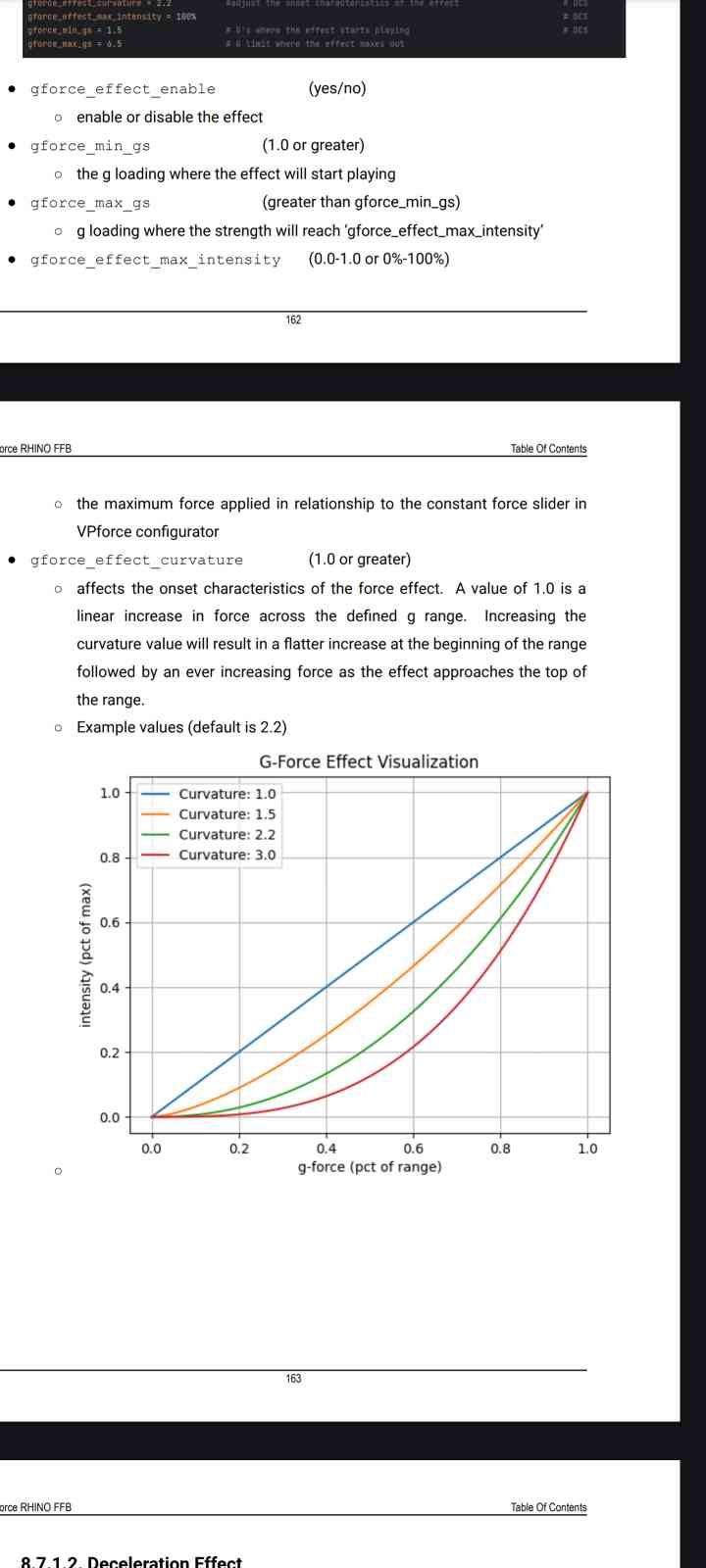
FI have telemffb set to have dynamic forces based on G loading from 1.1 to 10Gs using a curvature of 1 instead of the default 2.2. it works great for the F-14, F-18 and F15E.
 N
NIs their any way in your software to compensate/simulate for the lack of this telemetry in certain DCS modules??
I would have thought that the F-14 should have dynamic forces affecting it being a non FCS jet. Having tested the spring dynamic s settings seems you are correct in that it might make the stick have more spring resistance but there is no dynamic adjustment of the feel of the stick at different speeds, which is disappointing, but can be partially replaced by the dynamic G force effect although not exactly a great replacement. I'm in the middle of making a first impressions review to be quickly followed by a sectional review of the different types of aircraft in DCS and the benefits of having a FFB base in particular the Rhino in all of the different types of aircraft. With the F-14 being a Heat Blur module I would have thought they would have had this effect in their telemetry. Plus the offset of the F-14 stick makes it very difficult to fly at times having little pitch movement left available after trimming in certain flight scenarios.
Since the F-14 is one of my favourite modules having now flown it with FFB it's dropped down my list of fun jets to fly due to the lack of dynamic feedback. Maybe with future upgrades and FFB now becoming a thing for flight sims ED and MSFS and the third party developers will add full telemetry to all the modules in their sims. Not their fault since we have had nearly zero FFB equipment available in flight sims unlike the Sim racing community! But I can see it becoming a big thing now with several manufacturers bringing it out and at an affordable price!
I would have thought that the F-14 should have dynamic forces affecting it being a non FCS jet. Having tested the spring dynamic s settings seems you are correct in that it might make the stick have more spring resistance but there is no dynamic adjustment of the feel of the stick at different speeds, which is disappointing, but can be partially replaced by the dynamic G force effect although not exactly a great replacement. I'm in the middle of making a first impressions review to be quickly followed by a sectional review of the different types of aircraft in DCS and the benefits of having a FFB base in particular the Rhino in all of the different types of aircraft. With the F-14 being a Heat Blur module I would have thought they would have had this effect in their telemetry. Plus the offset of the F-14 stick makes it very difficult to fly at times having little pitch movement left available after trimming in certain flight scenarios.
Since the F-14 is one of my favourite modules having now flown it with FFB it's dropped down my list of fun jets to fly due to the lack of dynamic feedback. Maybe with future upgrades and FFB now becoming a thing for flight sims ED and MSFS and the third party developers will add full telemetry to all the modules in their sims. Not their fault since we have had nearly zero FFB equipment available in flight sims unlike the Sim racing community! But I can see it becoming a big thing now with several manufacturers bringing it out and at an affordable price!
NThanks I already use the G force effect in that manner although it's not a great replacement for the dynamic effect we should have of the controls at different speeds. I'm not sure what you mean by a "curvature of 1.0 instead of the 2.2" Is there an adjustment that can change this other than the start and end G ratings and the 0>100 strength factor that I am missing. Any help appreciated.
NUp until recently, it was not feasible to implement replacement/augmented dynamic spring forces in TelemFFB for DCS because as soon as you seize control of the spring effect, you are now responsible for every effect that leverages the spring, including trim forces. With the lack of detailed telemetry from DCS, it’s not possible to do cleanly.
With features in the latest firmware, I have some ideas for an advanced spring override that will allow DCS to retain control of the spring effect for trim, but allow us to augment/adjust the applied gain (using same concept as the setting in configurator, but tied to airspeed telemetry). There is also the fact that both IAS and TAS telemetry are bugged/wrong in DCS.
Bottom line, this would be best addressed by the module developer. HB knows how to do it (F4 is a prime example). That said, I have no frame of reference on how the 14’s controls should feel IRL.
With features in the latest firmware, I have some ideas for an advanced spring override that will allow DCS to retain control of the spring effect for trim, but allow us to augment/adjust the applied gain (using same concept as the setting in configurator, but tied to airspeed telemetry). There is also the fact that both IAS and TAS telemetry are bugged/wrong in DCS.
Bottom line, this would be best addressed by the module developer. HB knows how to do it (F4 is a prime example). That said, I have no frame of reference on how the 14’s controls should feel IRL.
NThanks and I know you are doing a great job and it's just a shame that this side of Flight sims has been neglected for so long that now that it has become fashionable the developers are just behind the curve on what is needed for this type of equipment.
 F
FYes you can change the curvature as explained in the manual
NAh I see you use the Legacy G-Effect hence why I haven't seen this curvature option before as I have only enabled the "NEW" effect so far.
NThe legacy g effect will provide consistent force at a given G loading because the applied force is a direct calculation of the G force and its point on the curve, but it can lead to a bouncy feeling on some aircraft because the controls are so sensitive it leads to large g-force swings with small control inputs. Most notably at low G's with a linear curve, or, where the curve ramps sharply with an exponential curve value
The new effect calculates the force the same way (using a linear scaling from min-max g), but it applies a further factor using the deflection of the stick from spring center. It solves the "bouncy" problem, but does not provide consistent force since at different airspeeds the "stick pull" to achieve a given G loading will be different.
Tough problem to solve external to the sim.
The new effect calculates the force the same way (using a linear scaling from min-max g), but it applies a further factor using the deflection of the stick from spring center. It solves the "bouncy" problem, but does not provide consistent force since at different airspeeds the "stick pull" to achieve a given G loading will be different.
Tough problem to solve external to the sim.
 R
RSeems good so far
 H
HJust though about it, inspired by this explanation. Considering the old approach, what if you use more smoothing (moving average) and/or hysteresis to fight the bouncing. That would lead to a delayed response of course, but perhaps that isn‘t all that noticeable (compared to the bounce/oscillating)?
FI tried the new G force effect and while I like the lack of bouncing it just doesn't give me the G force feel the legacy one does with a curvature of 1 since it gives me a precise indication of G forces. If there was a way to keep the feel of the legacy and somehow dampen the bouncing when going back to center it would be perfect! For me at least haha. Also it would be nice if it had an option for negative G forces like the new one does. For now I'm sticking to the legacy one and try to dampen the bouncing with my hand and dampening settings in the configurator.
FIn my testing the F-14 isn't as bouncy as the F-18 in DCS so the legacy G force logic plus some dampening works great with the tomcat. But this is only true if the trim has the stick forward. If I trim it to have the stick centered it's just as bouncy.
BAh, I missed that too. Thanks, never noticed that on the previous versions.
 I
IRhino got disconnected during flight in DCS and wont re connect, any ideas?
IAlrady re started PC
IIt does not show on wndows game controllers either
I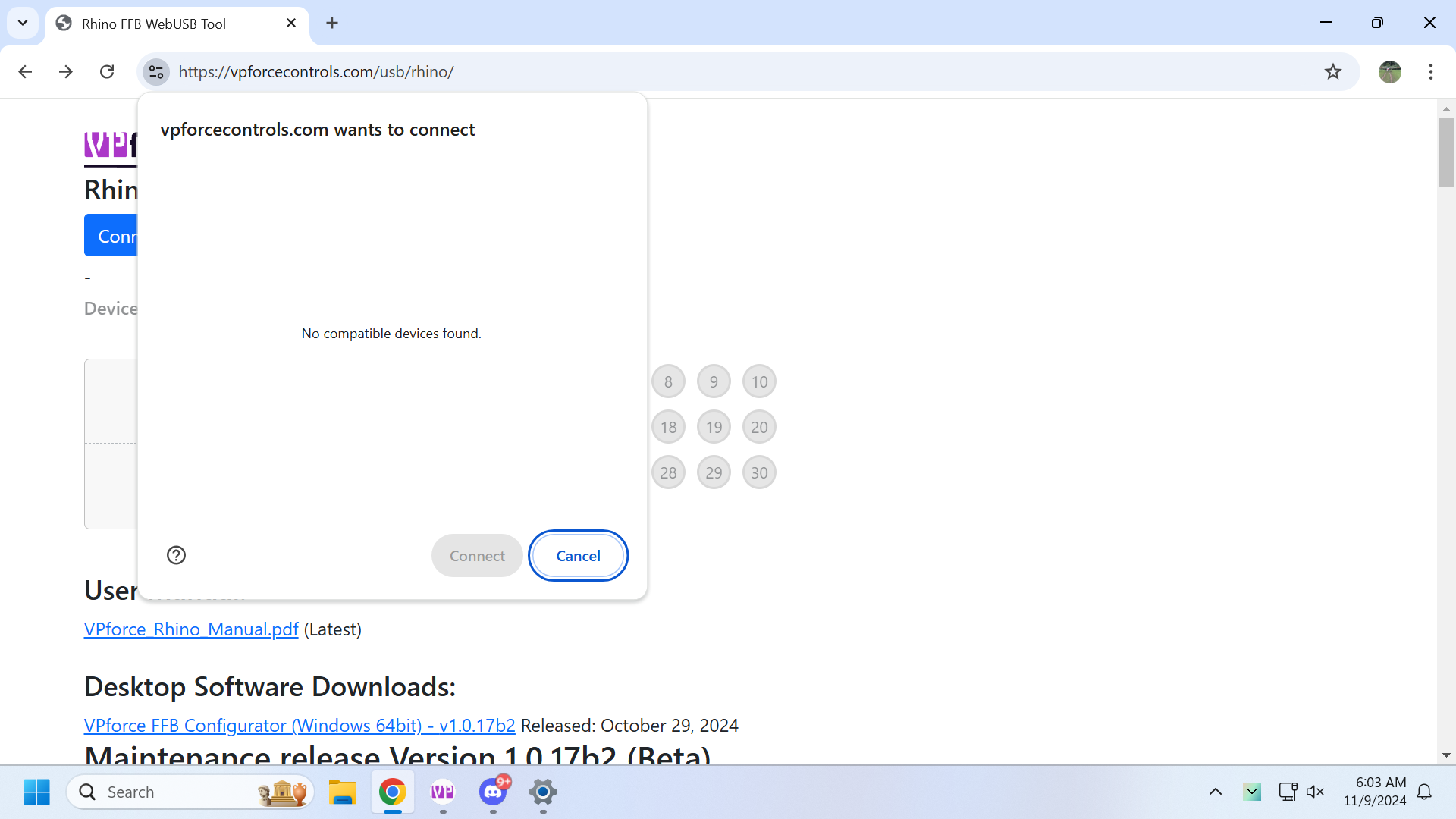 I
INo compatible device found message
IChanging to a different uSB por solved the problem, but why did this happened?

 D
DI've had this in the past, and since everything is plugged into quality hubs and always on the same ports, no more problems. That said, the vagaries of computing are really bizarre at times...
 C
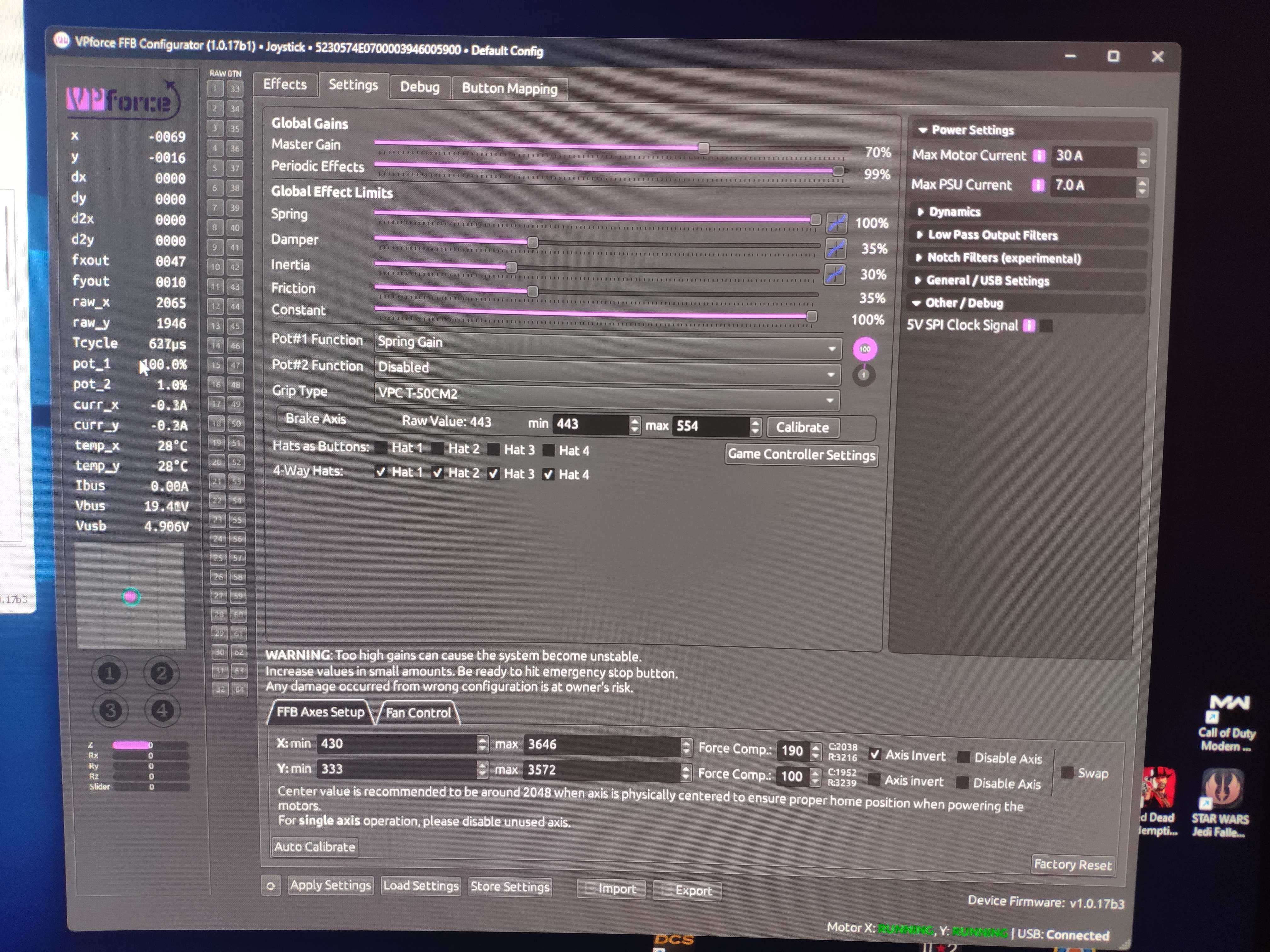
Chello, I have the message "Motor Y Status: FAULT_ISENSE_SATURATION" and my motor is disabling itself when it is occuring. what should I change in the configuration ?
 S
SI've got an issue in DCS with Friction effect generating persistent oscillation. I've loaded and stored the Factory firmware default in Configurator. Any ideas?


 T
TI've found issues with the Rhino on hubs that seem to be due to other devices on the same hub having too many endponts, even though they haven't maxed out the available ones for that hub. Usually removing one of those devices to give a little more headroom has gotten the Rhino back to working. Using USBLogView and UsbTreeView to look at what was going on.
TWhat flight scenarios leave the F14 without much pitch range after trimming? Starting out the F14 moves the stick center way forward, so for me usually trimming leaves the F14 stick pretty well centered.
 W
WDoes anyone have an idea what could be causing the joystick to tip forward in the H160?
Both running on Default TelemFFB presets, H145 B500, H160 B83, same settings, same control preset in MSFS
It doesnt occur with APs OFF
VPForce Rhino FFB Stick
h160: https://streamable.com/mky6lr
h145: https://streamable.com/jqc0d8
Both running on Default TelemFFB presets, H145 B500, H160 B83, same settings, same control preset in MSFS
It doesnt occur with APs OFF
VPForce Rhino FFB Stick
h160: https://streamable.com/mky6lr
h145: https://streamable.com/jqc0d8
Streamable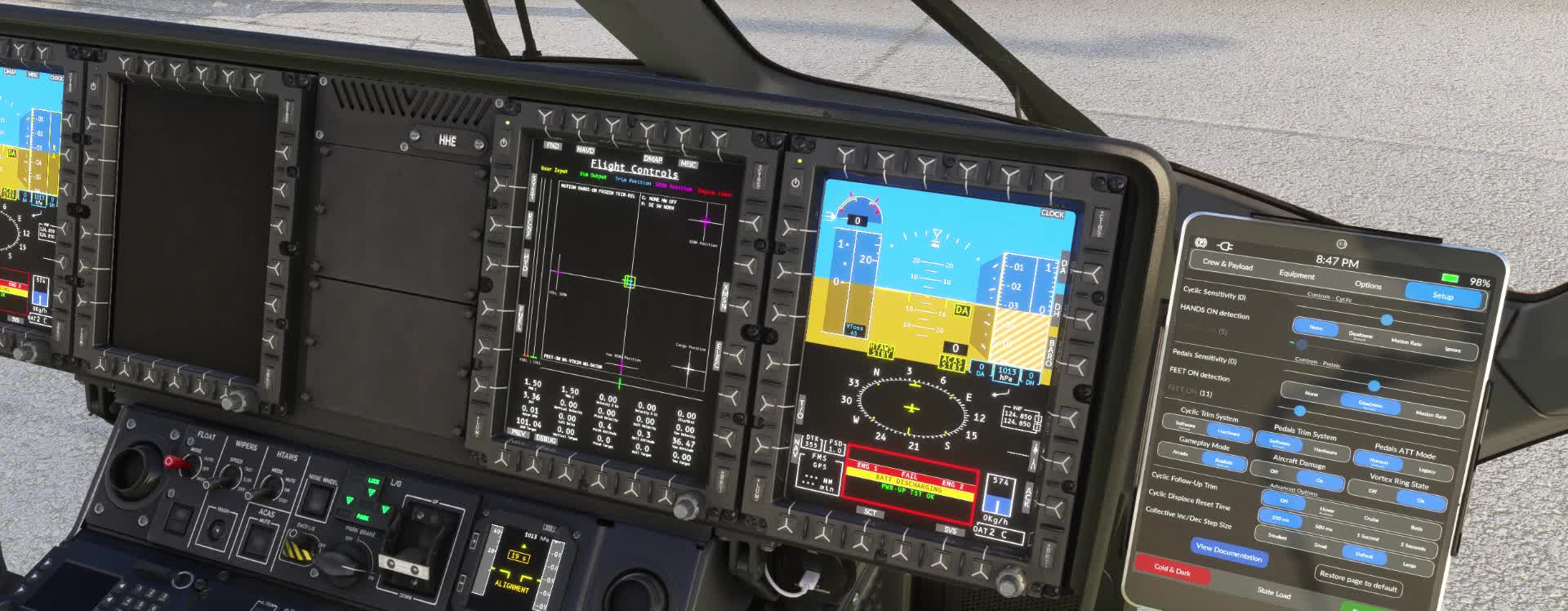
Watch "Microsoft Flight Simulator - 1.38.2.0 2024-11-09 20-47-16" on Streamable.
Streamable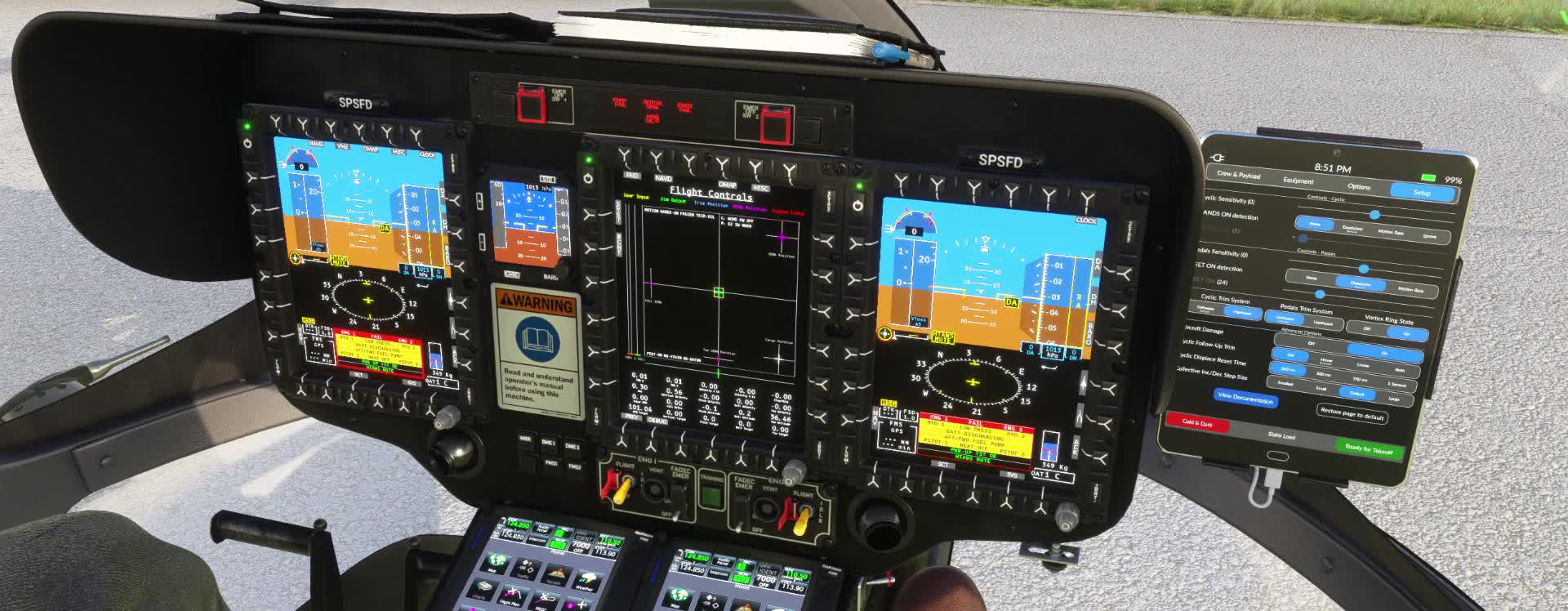
Watch "Microsoft Flight Simulator - 1.38.2.0 2024-11-09 20-50-55" on Streamable.
 D
DOk, thanks for your comments! I took the same actions as you and it's much better with fewer usb devices connected!
 D
DI had pretty much the same problem as you and I think @Number481 is on the case. Since the last TELEMFFB update I had HANDS ON with the default profile. Everything was working fine in the past. I was able to correct these odd elements by loading a profile from H145 which - itself - still worked. I changed all the names of my Airbus Hxx liveries (aircraft.cfg file) and associated all this with my old profile. Anyway, not necessarily your problem, but I have the impression that there's some weird behavior with these new updates.
Check out other liveries if you come across this (take liveries that aren't part of the hype, e.g. on flightsim.to).
Check out other liveries if you come across this (take liveries that aren't part of the hype, e.g. on flightsim.to).
DMaybe not your problem at all, but you can take a look at this and see if it helps.
 S
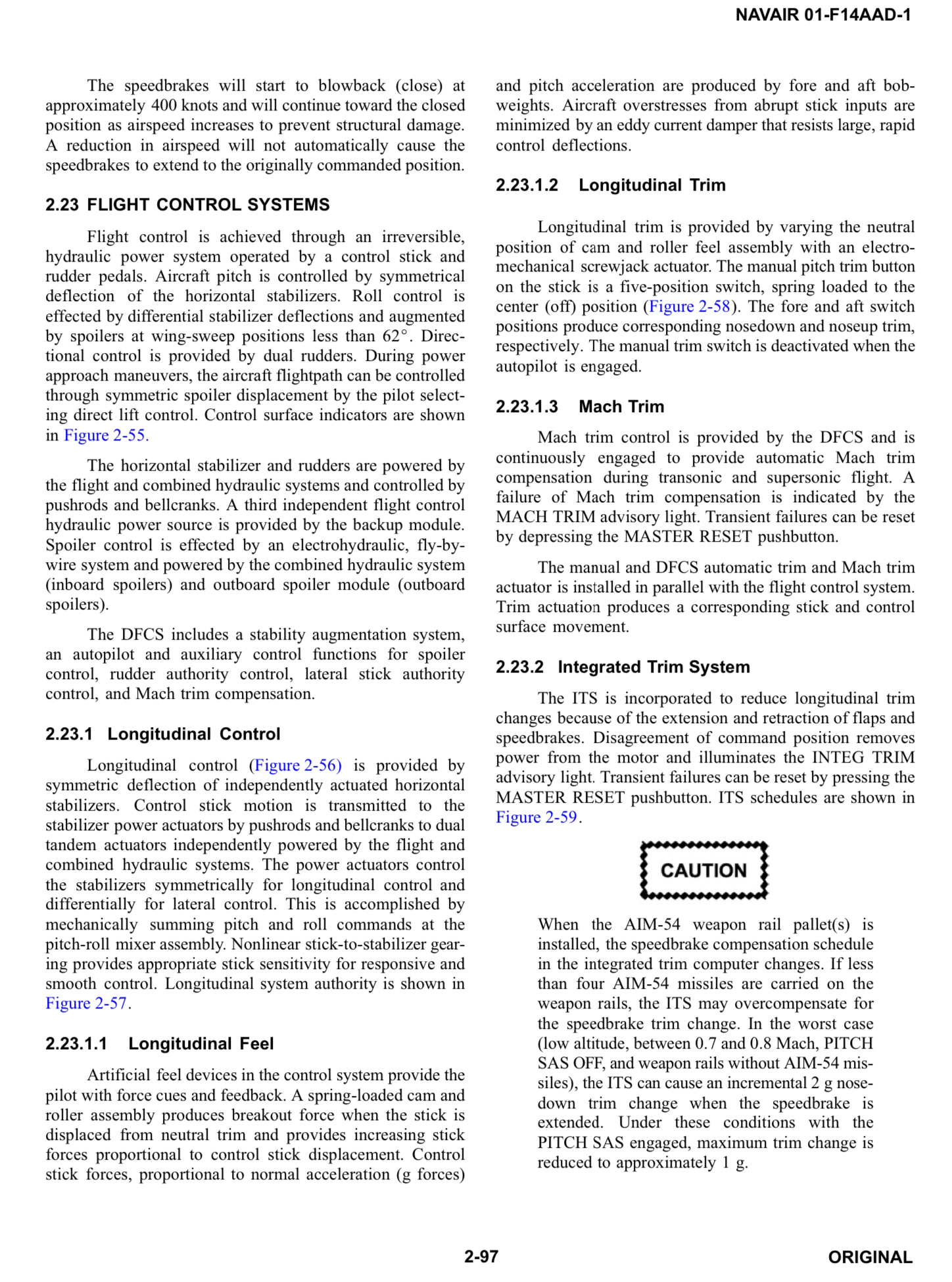
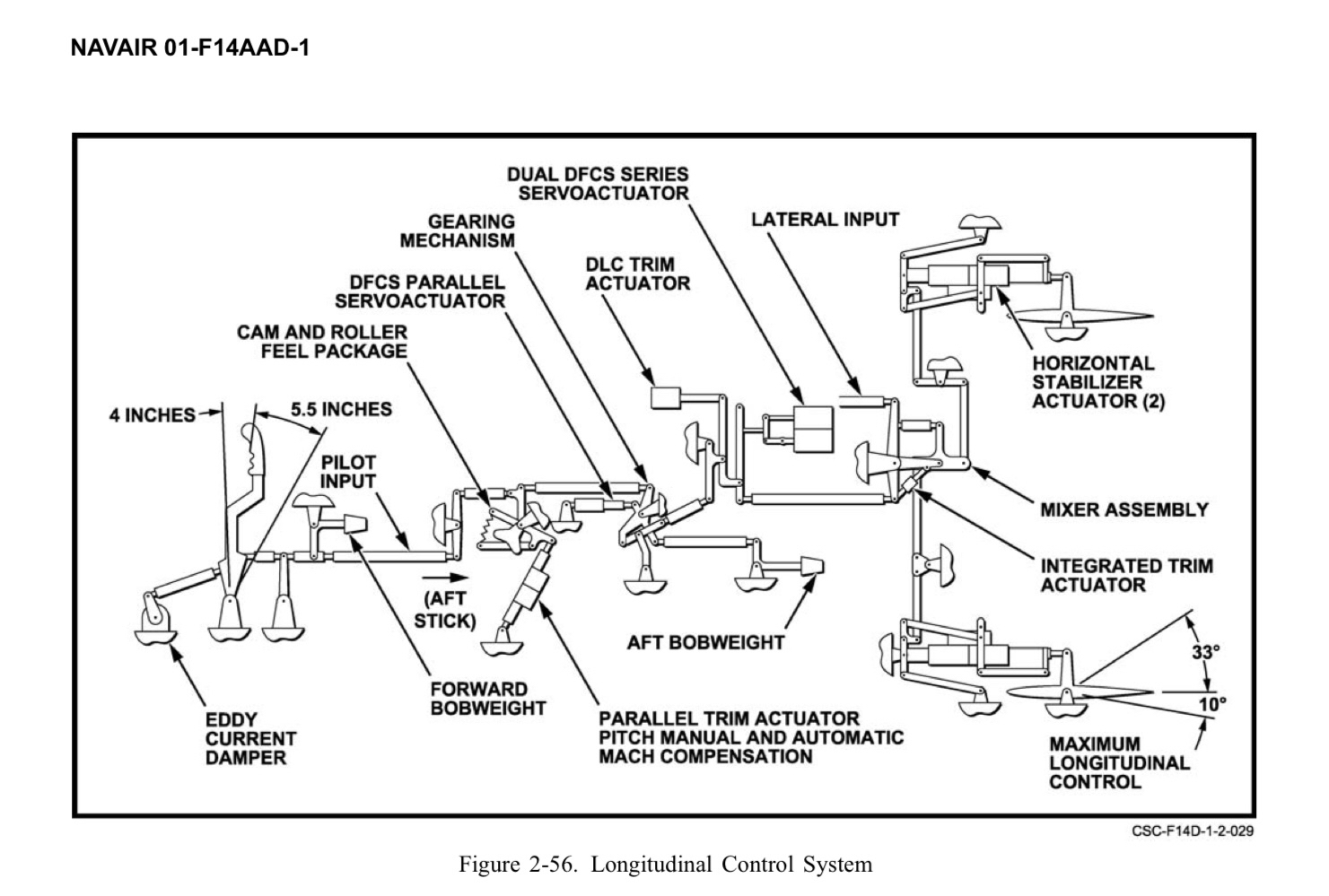
SEarlier there was discussion about F-14 control feel. These excerpts are from F-14D natops. Its for the D-model but I’d guess they didn’t change the control system between models. If I understand these correctly there shouldn’t be dynamic pitch forces that change according to speed. To me it seems that the module default spring effect, g-force effect and some damper to simulate the eddy current damper could be quite close to somewhat realistic feel.
 F
FThat's exactly what I based my settings on for the F-14
NSee my post on the Hype discord... definitely something wonky with H160 B83
 O
OI had a problem with a certain USB device preventing the Rhino from being recognized (on any port). There was no indication either except for deep, deep within the system.
 T
TMy order says it's nearing completion but my order number is in the 1600s, did I do something wrong?
 N
N@sydost That is a great find but totally proves the point that there SHOULD be an increased longitudinal (PITCH) dynamic force felt on the control stick under certain circumstances and it's all in one paragraph quite clear!
Extra forces should definitely be felt through the stick in 3 specific events and are artificially added to the F-14 control stick in real life
Event 1 normal Flight!
2.23.1.1 Longitudinal feel!
Paragraph one!
"A spring loaded cam and roller assembly produces break out forces when the stick is displaced from neutral trim position and provides increasing stick forces proportional to control stick displacement."
In other words if you pull on the stick you should feel the stick become harder and harder to pull against the further from the neutral trim position you try to pull the control stick. So a Dynamically increasing force is applied to the control stick of the F-14 the harder you pull on it. This is not related to pulling "G's" but simply a dynamically increasing force letting the pilot know how far he is from the neutral stick position during normal flight and this resistance would increase with the speed of the aircraft!
We currently DO NOT have this in the Rhino telemetry from DCS!
Event 2 Pulling G's
Following directly on from the previous sentence in the above documentation.
"Control stick forces proportional to normal acceleration (G Forces) and pitch acceleration are produced by fore and aft bob weights (similar in fashion to the F-4 Phantom) In other words the higher the G forces produced in a turn the harder the stick should be to pull against due to the influence of the bob weights fore and aft!!
This can be and is replicated by the G forces effect in Telem FFB software! and is the option being talked about by myself and @f14billy
Event 3 Sudden and dangerous large movements of the control stick!
Again continuing on from the last sentence in the paragraph 2.23.1.1 Longitudinal feel!
"Aircraft overstress's from abrupt stick inputs are minimised by an eddy current damper that resists large rapid control deflections!"
Currently not an effect we have from telemetry from DCS but I believe could be done using a Damper effect in the Config software and making it a sticky for the F-14 profile you use!
The entire description of how the F-14 should "feel" is in this entire paragraph.
The following is a quote from a real life retired RAF QFI that is currently my Flight instructor for DCS and has described to me personally what a pilot of any fast jet should feel realistically in flight.
Extra forces should definitely be felt through the stick in 3 specific events and are artificially added to the F-14 control stick in real life
Event 1 normal Flight!
2.23.1.1 Longitudinal feel!
Paragraph one!
"A spring loaded cam and roller assembly produces break out forces when the stick is displaced from neutral trim position and provides increasing stick forces proportional to control stick displacement."
In other words if you pull on the stick you should feel the stick become harder and harder to pull against the further from the neutral trim position you try to pull the control stick. So a Dynamically increasing force is applied to the control stick of the F-14 the harder you pull on it. This is not related to pulling "G's" but simply a dynamically increasing force letting the pilot know how far he is from the neutral stick position during normal flight and this resistance would increase with the speed of the aircraft!
We currently DO NOT have this in the Rhino telemetry from DCS!
Event 2 Pulling G's
Following directly on from the previous sentence in the above documentation.
"Control stick forces proportional to normal acceleration (G Forces) and pitch acceleration are produced by fore and aft bob weights (similar in fashion to the F-4 Phantom) In other words the higher the G forces produced in a turn the harder the stick should be to pull against due to the influence of the bob weights fore and aft!!
This can be and is replicated by the G forces effect in Telem FFB software! and is the option being talked about by myself and @f14billy
Event 3 Sudden and dangerous large movements of the control stick!
Again continuing on from the last sentence in the paragraph 2.23.1.1 Longitudinal feel!
"Aircraft overstress's from abrupt stick inputs are minimised by an eddy current damper that resists large rapid control deflections!"
Currently not an effect we have from telemetry from DCS but I believe could be done using a Damper effect in the Config software and making it a sticky for the F-14 profile you use!
The entire description of how the F-14 should "feel" is in this entire paragraph.
The following is a quote from a real life retired RAF QFI that is currently my Flight instructor for DCS and has described to me personally what a pilot of any fast jet should feel realistically in flight.