The problem is that we don't know the true maximums. The system can have different motors / drive ratios / weights and that contributes to different stability margins.
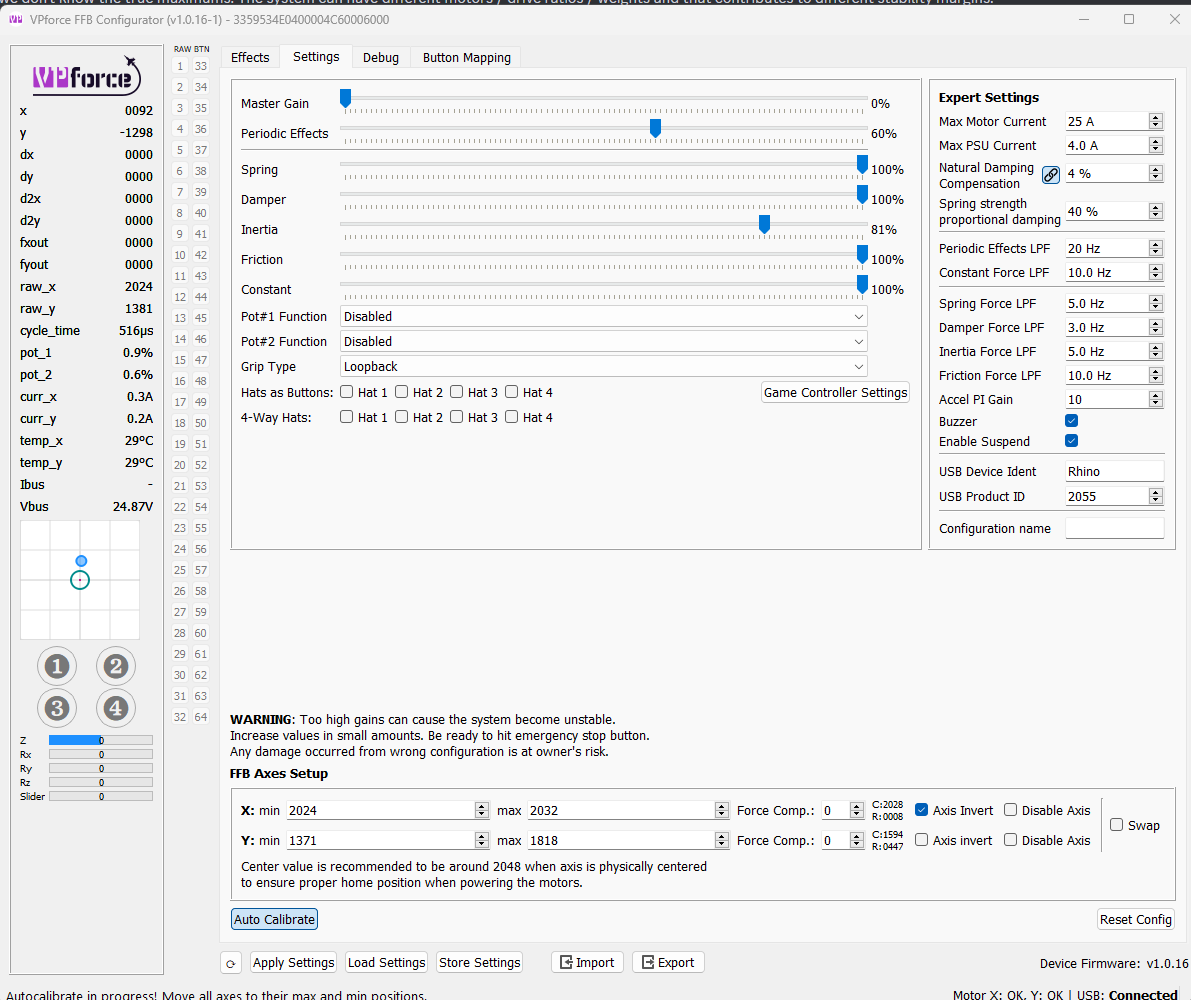
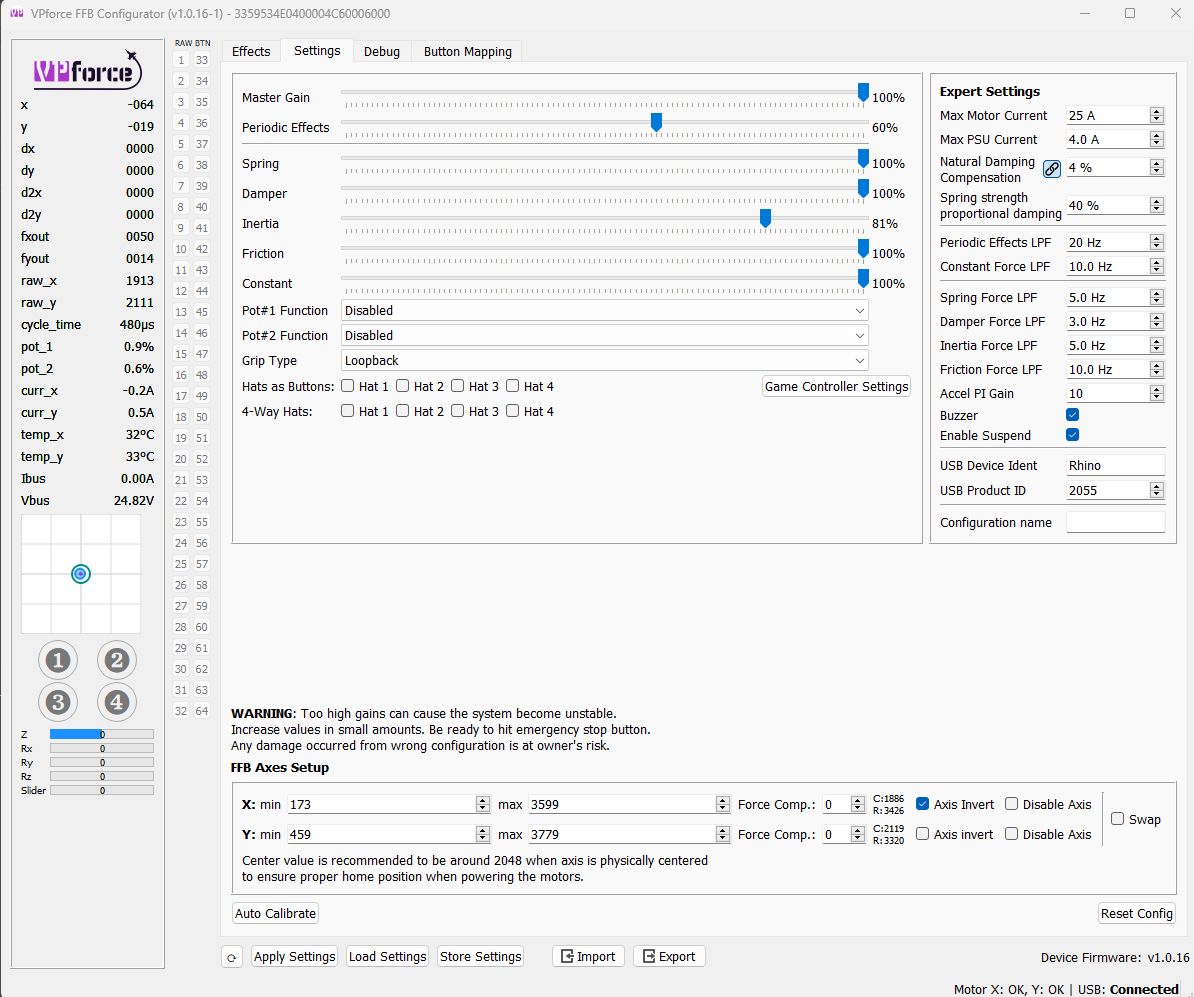
The sliders in the Settings tab set the per effect global limits
The basic effects in the Effects tab (such as Spring, Damper) create a on-device effect similarly how an FFB application would and adheres the limits set in the settings tab. Those effects (in Effects tab( are overriden when an FFB application takes over.
On one end it lowers the force we receive from the motor by moving the center out.
On the other end (our end) think of it like a lever, or more like a pry bar or what’s commonly called a breaker bar for taking apart BIG stuff.
The more distance you have the greater force you can exert (and by resisting it as well).
Sort of like trying to take off your tire with a short socket wrench takes a lot more force than it does with the long lug nut break bar.
Same idea but backwards so.. yep an extension allows you to push harder with the same physical force.
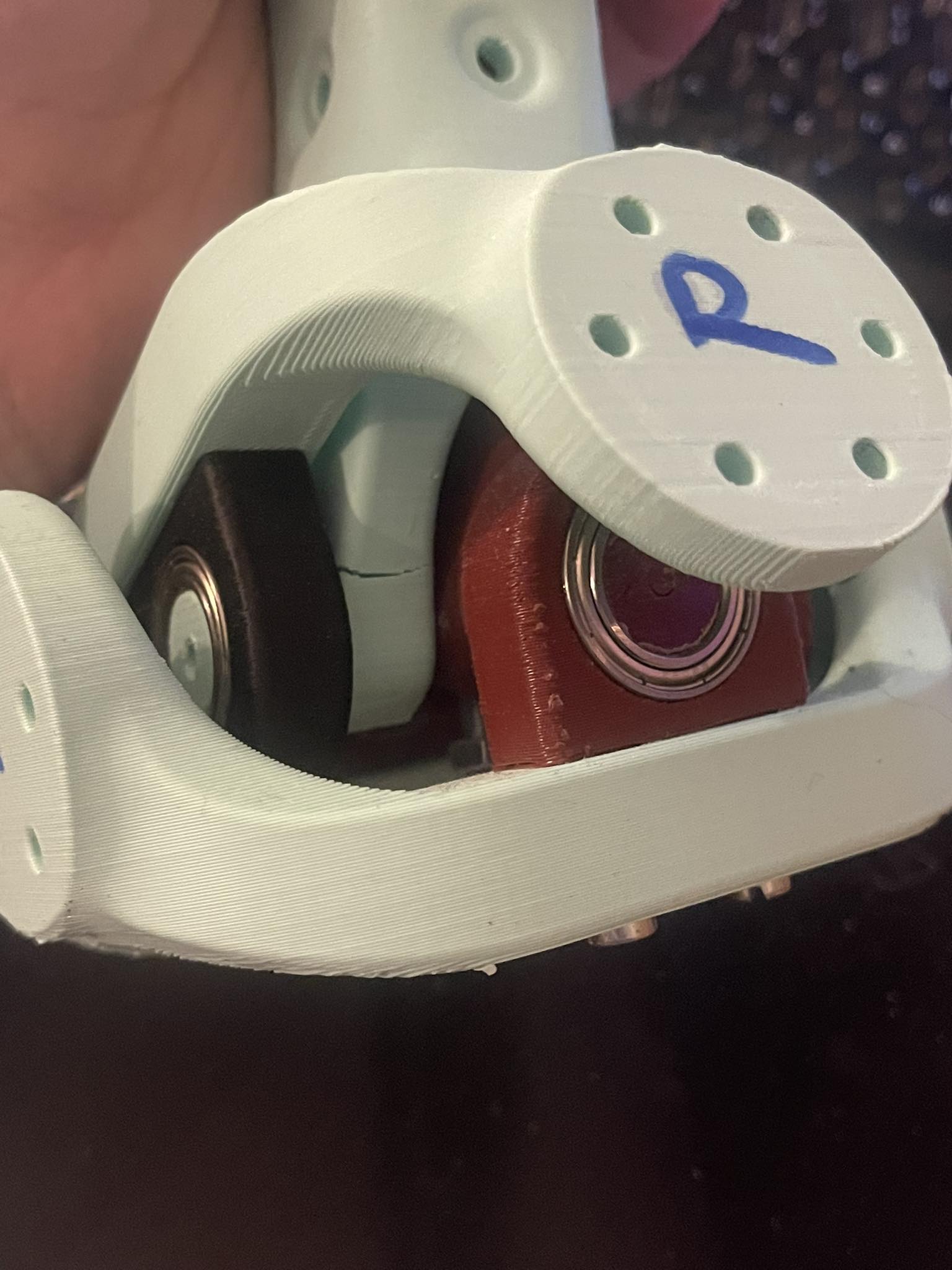
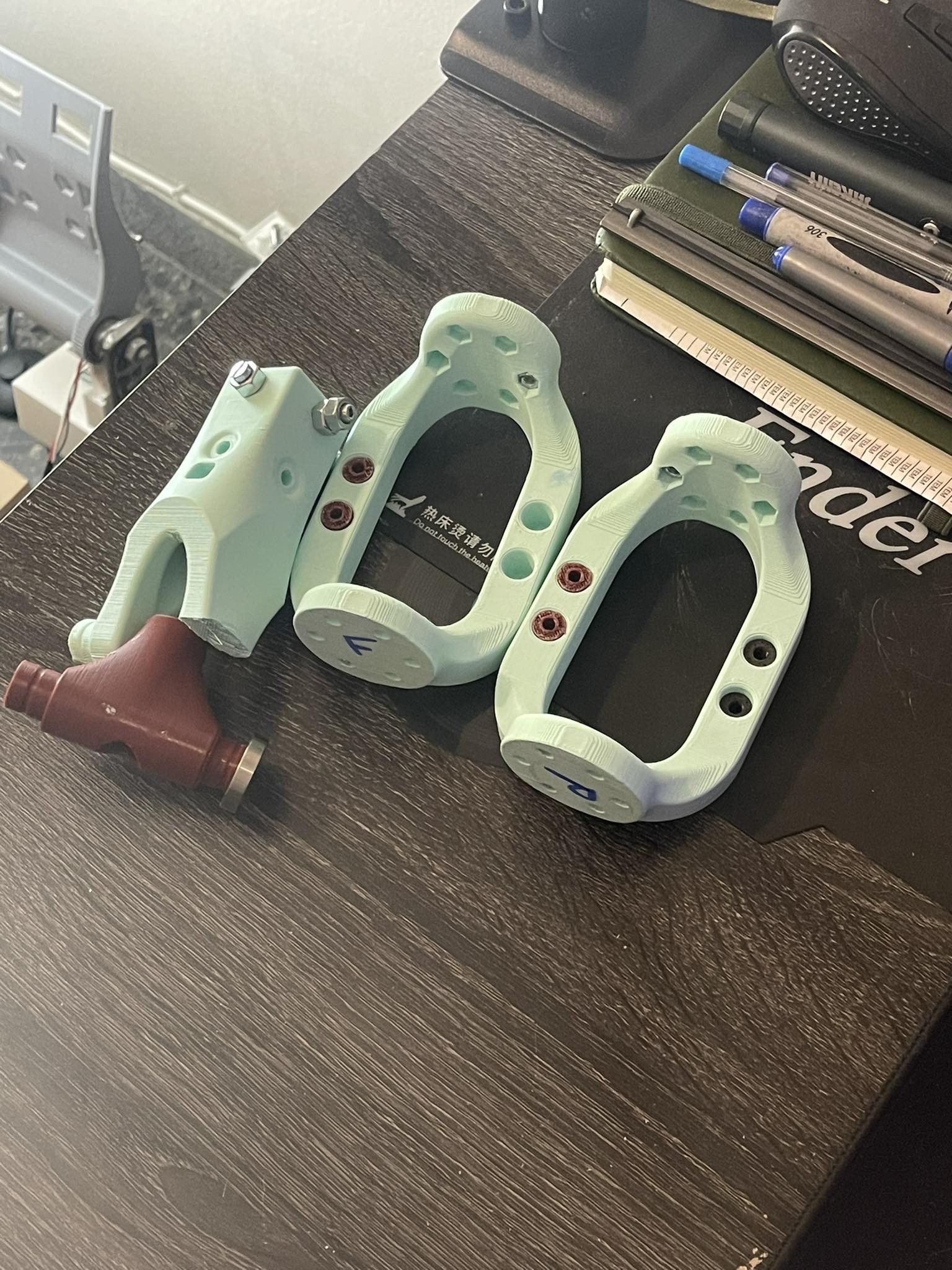
The other main culprit with ANY 3D print is flex and failure over time.
In other words sometimes S just happens but the beauty is you can just print another.
Facts are parts sometimes fail and that’s just part of the DIY game.
Thanks for sharing though because I’m ALWAYS interested in part failures and if they can be mitigated or if it’s just a wear and tear thing, print orientation thing, soooo many variables to consider so again thanks for sharing.
hi, I answered you in the DCS-forum as well. I think a 40cm extension is quite excessive for a 3D-printed gimbal. Leverage and so..... It seem to have broken along the layers. Have you printed it yourself? If so, try to print it in a different orientation (make the layers perpendicular). It may look less nice, but is stronger.
ideally, I would print it, so that the layers are oriented on the roll axis, when the stick is assembled. That would give the greatest strength towards the pitch axis, where (assumingly) the greatest forces are applied.
maybe pin this answer - It is valuable explanation. I got it completely backwards (which gives probably the same result, but still - this is helpful in understanding the software)! TY
As I undertstand it, the effects-gains and settings-gains are multiplied with each other (and then multiplied by master gain) - so in effect it probably doesn't matter on which side you adjust them, as long as the product isn't too high. @walmis , please correct me if I got it wrong.
It does matter - Settings in the "Effects" tab are overridden by application, and have no effect when the application drives the Spring for example. So in order to tune down the strength of the effects you need to set via the sliders in the settings tab. An example: Let's say an application creates and sets a Friction effect to max : 4096 (100%) and you have no control over the application. In this case you set the Friction slider to an acceptable value, for example 30%.
Ok - understood. Than my conclusion would be, it is better (safer) to put the effects settings to 100% and control the overall strength with the settings page? (And or master-gain)
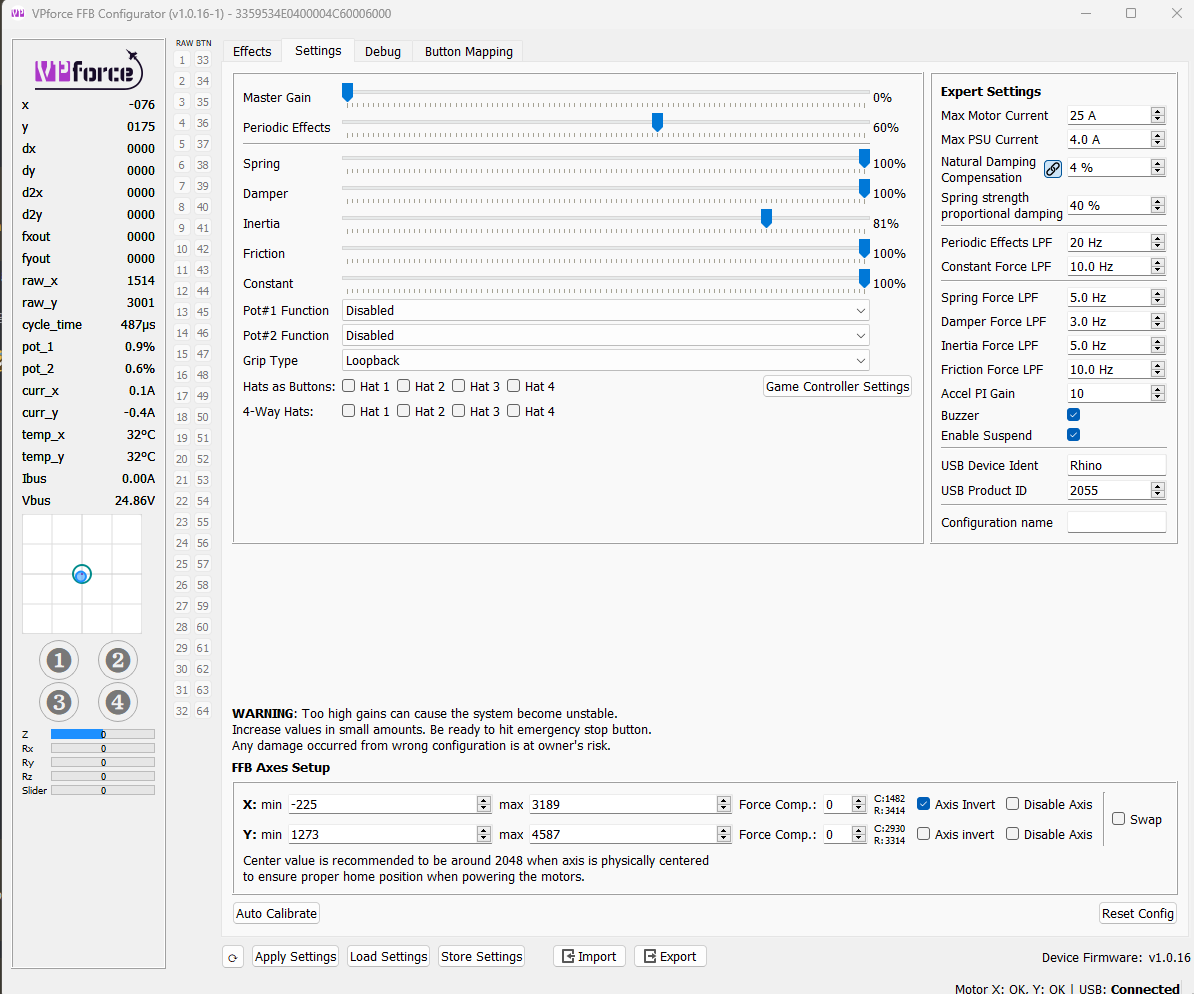
Unfortunately when I hit reset, as the motors weren’t responding, all the settings were reset to a ‘conservative’ setting. I could not find an image of the default settings after that, and anytime I restarted the software the new settings were showing, which were all 0
There is a default Rhino config in the configs/RHINO-defaults.vpconfconfigs/RHINO-defaults.vpconf, click import then store config. Also make sure to to run auto calibration after, since your calibration was reset too probably.
And do you have any solution for the F14 stick problem? If not then I’ll need to get another adapter. In the end I was able to hammer it down but there is no way it will come off now
How can I fix this behavior? This is in dcs with the apache. I hold trim release and move the stick, but the center does not remain where the stick is physically and when I release the trim button the stick moves back to a different "center" than where it should be
The shaft itself. Even on the vkb extension there is a little bit of resistance compared to the gunfighter, but it feels like rubbery resistance and goes down fairly easy. But on the VPFORCE extension grip it takes more force than I can put on it. Only way was with a hammer
Is it normal? I use spring gain 20% with Max current 30A. So when full draw, axis current should show ~6A. But full aft shows 6.6~6.7A whereas full fwd, left and right shows ~6A
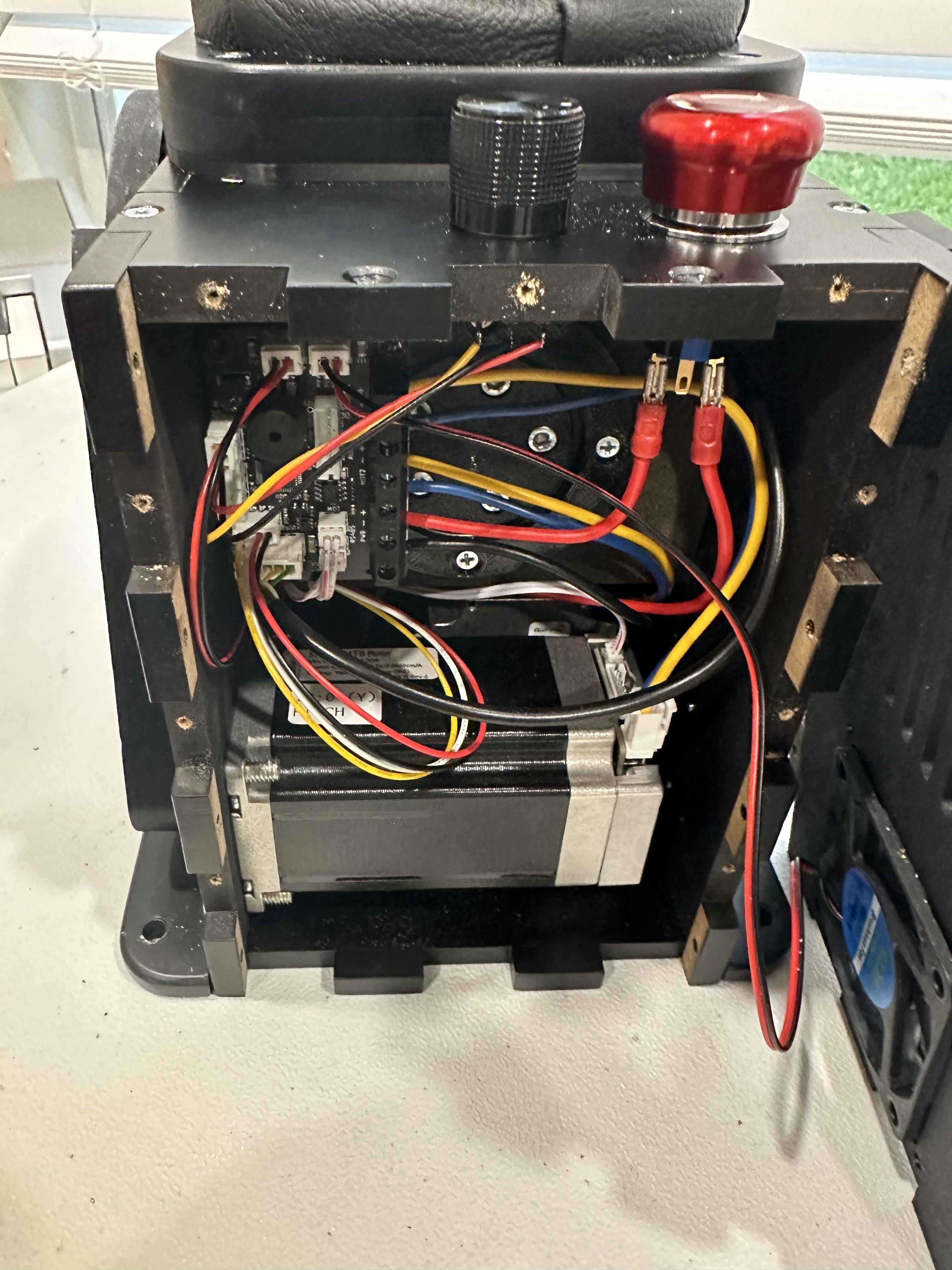
Speaking of currents, I have a question about the motors: If I noticed correctly the fan activates when either motor (usually the pitch) reaches 50 C and turns of when under 45 C give or take, but I wonder what would be the critical temperature for the motors before they take damage? I can’t find any specs about it. 60, 70, 80 C…. when will they take damage? I’m asking, 1. out of curiosity and 2. because I will use the same motor and pcb in my pedals-mod, but without a cooler. I assume it will work out, but who knows….. (btw. when will the current limiter set in?)
I guess the limiting factor would be the motor's magnet curie temperature, at which they start to demagnetize, which is unknown. But anyhow the motors are thermally limited, similarly how GPUs self limit to maintain a stable max temp.
So, soon to get my order thingy. Im in the processing stage, has anyone used the base with a thrustmaster warthog OG grip? I'm worried about the metal thing breaking. What sticks are you guys using? Sorry if its the wrong channel
I think anticogging for y axis is not working perfectly. I could feel minute bump at a center of y axis movement(x axis is perfectly smooth). Can it be caused by a belt is too tight?
FWIW I had a similar situation which was solved by removing 20 cm extension + VKB adapter and installing a 10 cm extension. Never found out which one caused it. The bump/noise was also only in Y axis like in your case. Could be something completely different though and idk whether you are even using an extension or adapter.