 F
FI’m a brand new and (so far) happy Rhino owner. I’ve browsed read the official Rhino manual and read various threads here on the Discord server and I think I have most things set up the way I want. I play only DCS and mostly fly the Apache. One thing I’m still unsure about is curvature, saturation, and dead zone of the “control output” (not the ffb itself). From what I can gather here on the forum, I’m not supposed to set any of those in DCS as they will interfere with the trim of the Apache. On the other hand I can’t find any way to adjust saturation, curvature, or dead zone in neither the VPforce Configurator nor the TelemFFB software. Is it correctly understood that there is no way of adjusting those, or have I simply missed something obvious?
 R
RI would like to know too!
RDo people have different VPForce Configurator settings for different aircraft?

 M
Mdid you break a flap ?

 A
Ano
Mok because in both situations are you describing things that can happen when a flap gets stuck after takeoff / wave off / touch and go on the turkey without retracting them soon enough
Atouch and go and wave off you never retract them, but a broken flap shouldn't give untrimmable full left stick either way
Mwell i dont know what you were climbing to or where in the pattern you were going but i understand
Afor both of those you climb to 600 ft along brc once past the landing area and proceed downwind on interval
Mok, i have no idea then
Msomeone will know
 A
AThere are no curves or dead zone settings with the rhino currently
AI fly the Apache with no extension and I think with the higher spring forces with force trim it mostly alleviates the need for any curves
 N
NWhile the rhino firmware does not support curves as amadeus said, this is purely a DCS thing. Call it a bug or a limitation or whatever, but FFB is just not compatible with curves and/or saturation adjustments. The FFB "spring center offset" is linear, so when the axis logical position is thrown off by a curve, bad things happen because the physical location on the linear FFB line does not match the logical position on the curved axis line. This infographic walmis created also shows why it doesn't make sense to move the center position on the curve. 📃general It might be possible to move the center of the curve itself but that would be... hard. But its important (for me) that you understand its a DCS thing since it is in control of the FFB center offset.
I've never been a fan of curves and always preferred saturation/scaling. Expecially in helicopters where you rarely if ever use full stick deflection. Unfortunately that does not work will in DCS either.
What you can do (I've suggested a specific feature/setting in configurator for this) is artificially increase the calibrated range beyond the stops in configurator.
For example, if your calibrated range is 1275 to 3003, simply subtract/add an equal amount from both ends. 1075 and 3203 as an example. This will cause the full physical deflection of the stick to only amount to a partial excursion of the in-game stick, which is exactly what the saturation does for reducing sensitivity.
I've never been a fan of curves and always preferred saturation/scaling. Expecially in helicopters where you rarely if ever use full stick deflection. Unfortunately that does not work will in DCS either.
What you can do (I've suggested a specific feature/setting in configurator for this) is artificially increase the calibrated range beyond the stops in configurator.
For example, if your calibrated range is 1275 to 3003, simply subtract/add an equal amount from both ends. 1075 and 3203 as an example. This will cause the full physical deflection of the stick to only amount to a partial excursion of the in-game stick, which is exactly what the saturation does for reducing sensitivity.
 A
AI'm fairly confident I don't for roll/pitch, but I will double check when I get home.
 F
FThanks for the thorough explanation. Highly appreciated! I agree that curves are not optimal but saturation would be nice as you suggest.
In the meantime I’ve tried the “workaround” with the calibration axis that you suggested and that seems to work quite well for achieving the roughly 80% saturation that I was looking for. Great tip. Thanks
In the meantime I’ve tried the “workaround” with the calibration axis that you suggested and that seems to work quite well for achieving the roughly 80% saturation that I was looking for. Great tip. Thanks
FI fly the Apache without an extension as well and it works well most of the time but for the hovering it would still be nice to have saturation, curves, or dead zone, mostly the former. But I’m still adjusting my muscle memory from my previous spring-based stick setup so maybe I just need a bit more practice 
ABetween using the adaptive recentering feature, and spring forces at 100% with a telemffb setting of like 20% damping, I find it quite manageable. Like all changes, there is an adjustment period, but I’ve become quite fond of this setup
 H
HIt seems pretty well documented if someone is capable to implement something less trivial what we have at the moment.
https://numpy.org/doc/stable/reference/random/generated/numpy.random.normal.html
https://numpy.org/doc/stable/reference/random/generated/numpy.random.normal.html
NExcept that we dont generate "a signal". At every simulation frame we have the opportunity to start/stop/modify one or more periodic effects. Those effects have an
- intensity (amplitude)
- direction (0-359)
- Frequency (Hz)
- Phase offset
- Shape (sine, square, triangle, sawtooth).
You cant "add noise" to a effect At any point in time it is what it is based on the agruments above.
You can create additional effects with offset values that will create an oscillation/warbling when they are played simultaneously based on the interference of the signals.
- intensity (amplitude)
- direction (0-359)
- Frequency (Hz)
- Phase offset
- Shape (sine, square, triangle, sawtooth).
You cant "add noise" to a effect At any point in time it is what it is based on the agruments above.
You can create additional effects with offset values that will create an oscillation/warbling when they are played simultaneously based on the interference of the signals.
 R
R@walmis did we discuss increasing the adaptive centering force or allowing us to adjust up to, say 25% of master setting, to get a snappier return or more consistent return with those using longer extensions and if its a viable request?
Ri can add to the request thread if needed for tracking

 H
HYou can edit the spring gain curve to achieve that. Make the first part of the curve steeper ét voila.
Ai think it's also worth bearing in mind that games can apply a higher spring force than what we can apply in the configurator
Aso if you're playing around with it, using 100% spring force in the configurator, it's possilble for DCS modules to go higher
HYou talk about the effects gains or the settings gains? Because as I understand it, that‘s only true for the effects gains (which can be overwritten by the game) but not for the basic settings including master gain.
Ai'm mostly referring to the perceived power of the spring force
Ai don't know how they pull it off
HAs I understood it, it works like factors. Master gain (100%) x Settings gain (100%) x effects gain (which can be overwritten by the game) 100% gives maximum force output. Either factor can be reduced, but you can’t get more than what is set in master and/or settings gain. An effective way to limit maximum force.
Ai think what I'm getting at is: with spring set to 100% in configurator is not the strongest spring force/pull you can experience is all, so you can be decieved by thinking this is the hardest a spring will pull me in, and the game can mess with it in other ways, so i worry if you mess with the spring gain curves, you might get yourself into some strange scenarios when game effects mix with gain curves
HYou need to specify which spring setting you are talking about. The effects tab gain will be overwritten by the game (unless you make it sticky), including the curve as far as I can tell. The spring gain on the master settings tab can’t be overwritten by the game. So, it will always limit the maximum force output.
Ayeah i'm only talking about the only custom gain curves you can set in spring settings
Abut my point is you're previewing that against a spring force that you apply in the configurator
Awhich is not necessarily what you'll experience in a game
HNo, of course not, because those don’t apply to a game that supports FFB. But if you preview them with a gain of 100%, I think the game can‘t exceed that.
Ayup yup
 R
RBut i cannot adjust the 15% of master spring gain when adaptive centering is pulling the stick back to center after trimming. THats what im wanting to adjust.
 C
CI'm ready to give up , my winwing adapter doesn't work. Can someone please tell me a cable I can order on Amazon or somewhere to replace it? I have properly threaded extensions so I just need the cable type. I don't even care that I'm out the money for the adapter. I just need my rig up and running. Thank you!

 W
WGoogle Docs
Order request for VPforce products.
Please note: to reserve a VPforce RHINO FFB base, please use reservation form here.
Once the order is ready to be fulfilled an invoice will be sent to the provided email address.
Please note: to reserve a VPforce RHINO FFB base, please use reservation form here.
Once the order is ready to be fulfilled an invoice will be sent to the provided email address.
HMy suggestion was that you don't need the adaptive recentering, when the basic recentering works better. But of course your milage may vary. For me the solution worked quite well for resolving the poor centering (for pedals though).
RMike station is too long. The regular centering isn’t very accurate. I have to use balance, spring, and adaptive centering to keep the stick centered to the height of the stick unless you can show me how to keep the sinner of the stick at 100% spring gain and move towards 60% as I get away from the center
 F
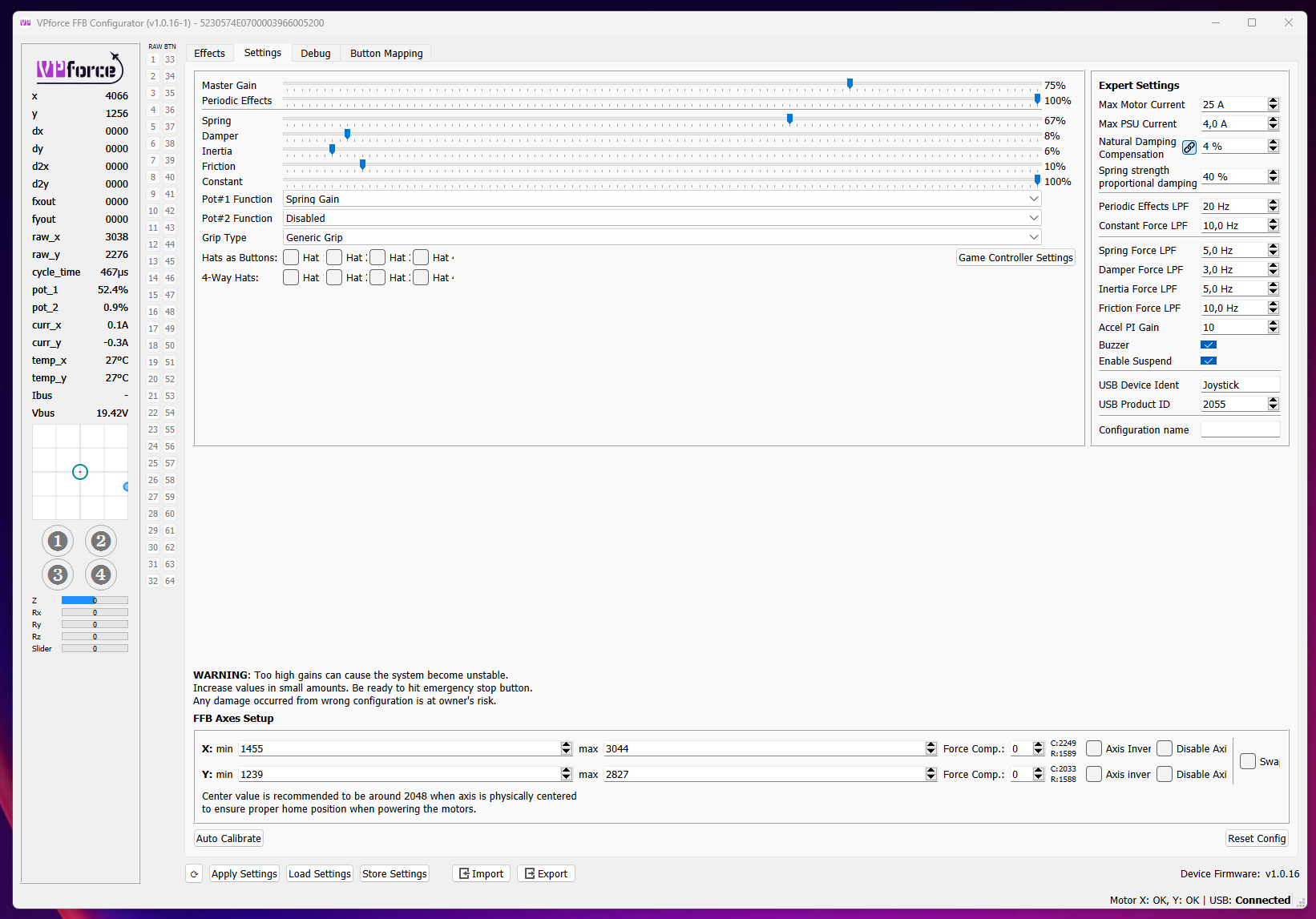
FI lost all forces, the joystick itself works. Restart of stick and computer did not help. I reset it to factory settings, does not help either. Any advise?
 W
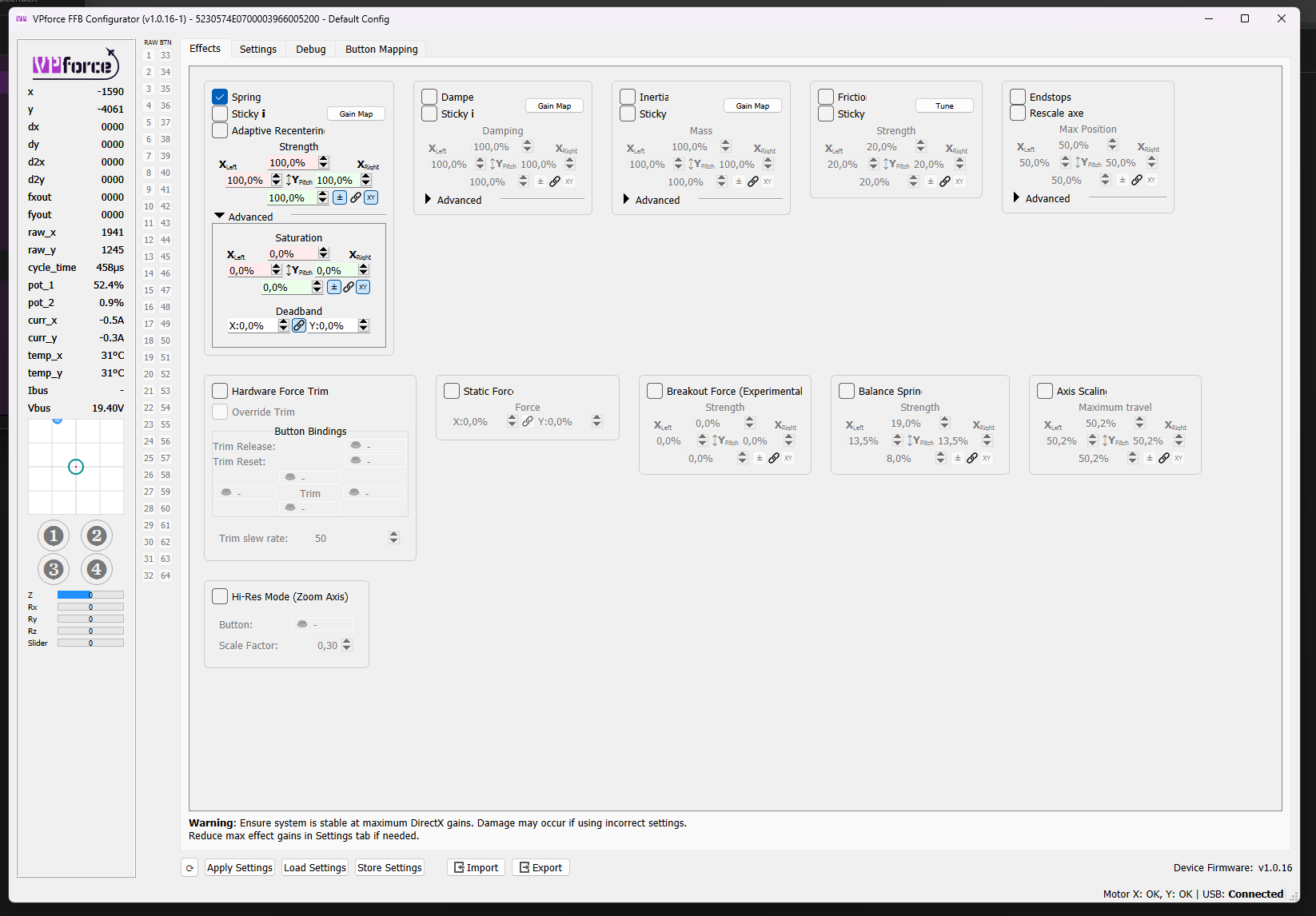
WEnable Spring in the Effect tab, everything else looks good. You might want to import the default Rhino configuration file from "configs" directory inside the VP configurator folder.
 F
FI did and applied the changes, it beeped. Also I loaded the default config. No force.
 W
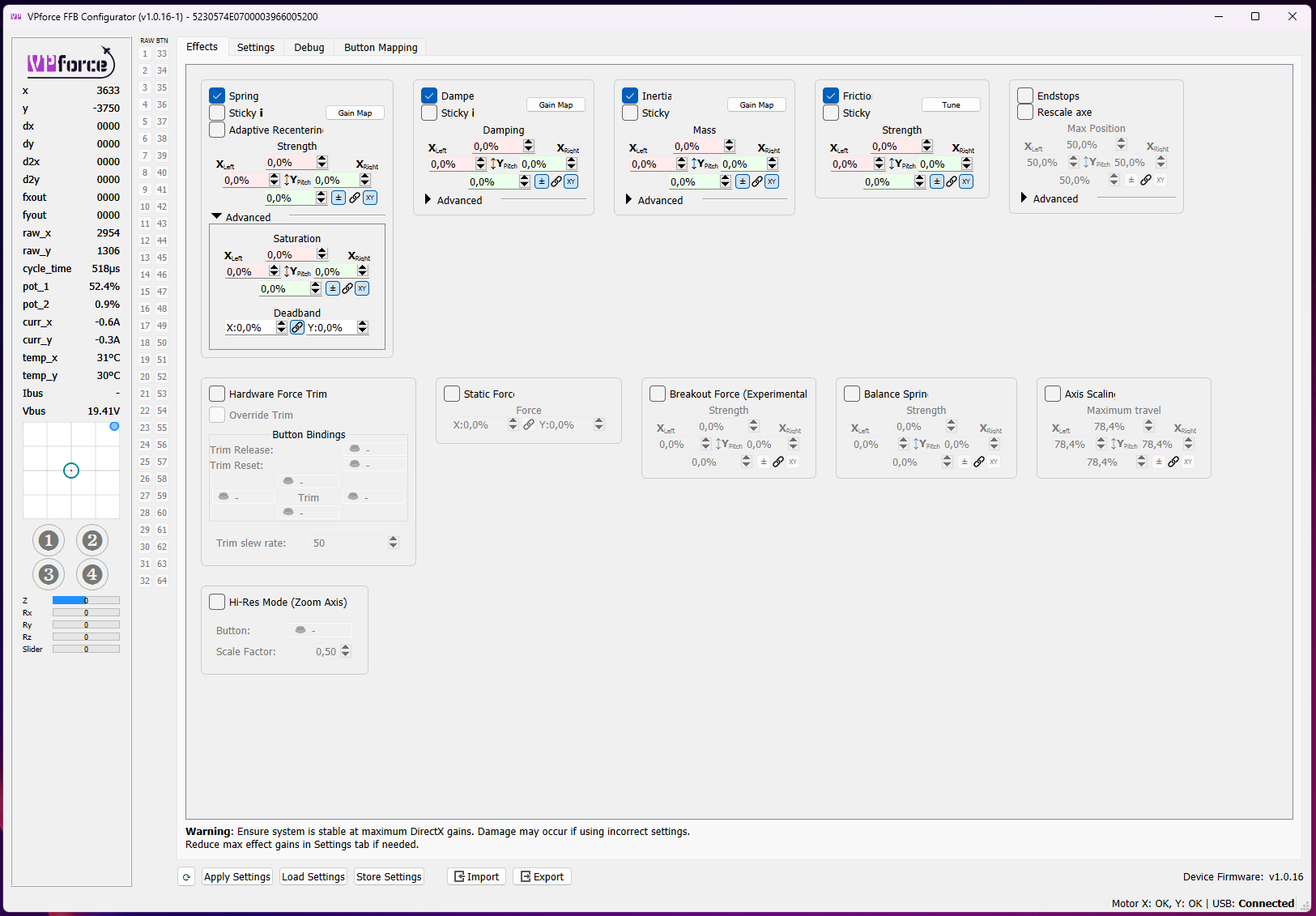
WThe spring effect strength is at 0%
FOh, that screenshot was before I loaded the default config. I missed that. Still, after loading the default Rhino config and spring effect strength at 100 the issue persist.
 H
HWhat happens when you reset the motors in the debug tab?
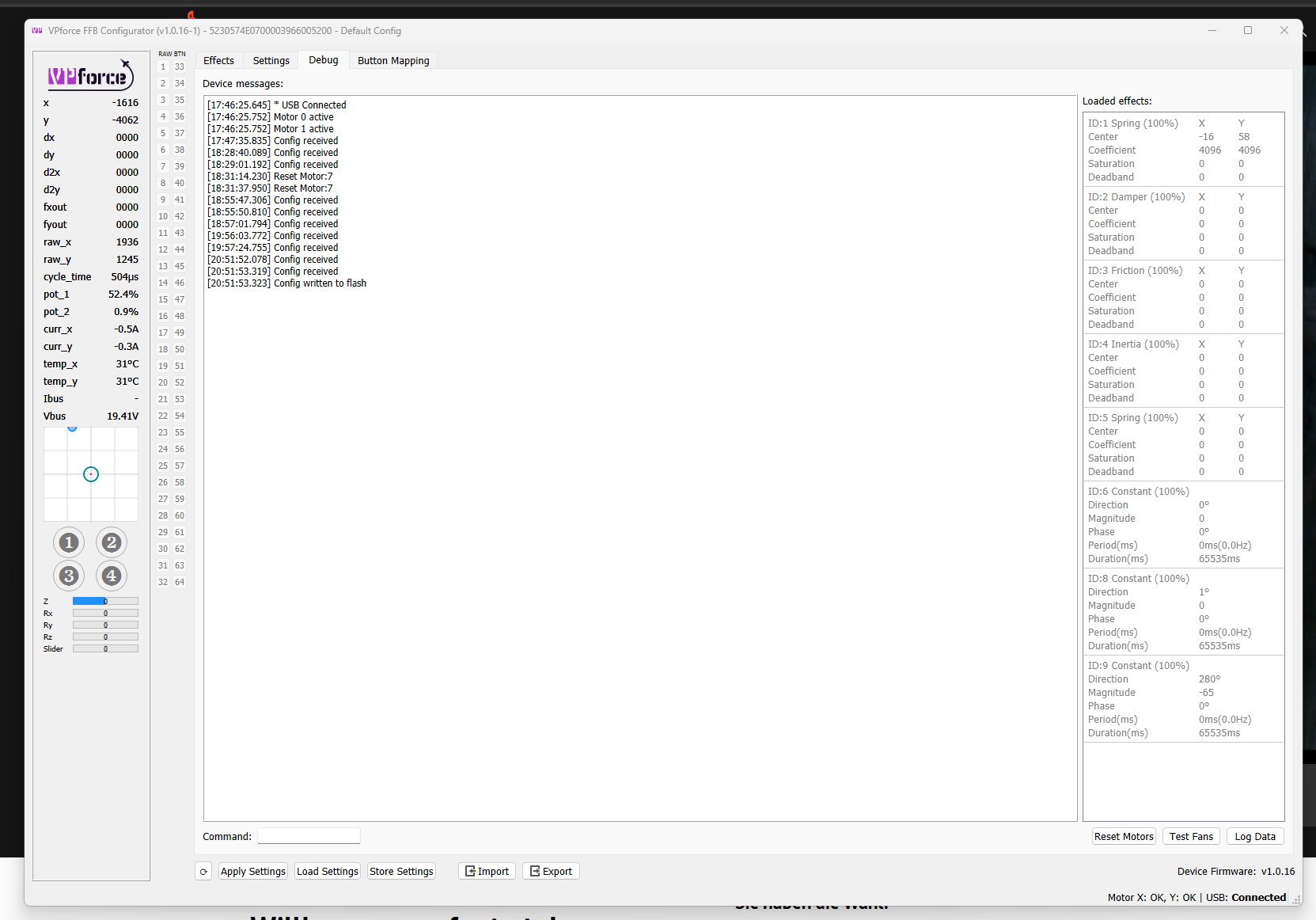
Awhat does your debug tab show?
Fthe two resets were made by me.