yeah this is cool but this is also a bit obviously skewed, I am wondering about demoing like specific features say we have a mutex problem and we try to solve it with FreeRTOS and Zephyr but on the same architecture
Say something like 2 tasks wants to share 2 uart to communiicate with a terminal, we could implement this on stm32f4 on zephyr and same on stm32f4 on freertos, then step back and look at the differences between both approaches, would you be keen on that @melta101
maybe it would be interesting to see how different feature's been used in frameworks like FreeRTOS & Zephyr. How things are handled differently from configuration to handling common issues.
Hey @Event Pings, we're going to be getting started with this week's Office Hours in about 30 minutes.
Excited to hear from @Middleware & OS devs in particular to come share your experiences with open source technology, and perhaps lend some tips to your fellow devs so they can avoid any OSS pitfalls in their development.
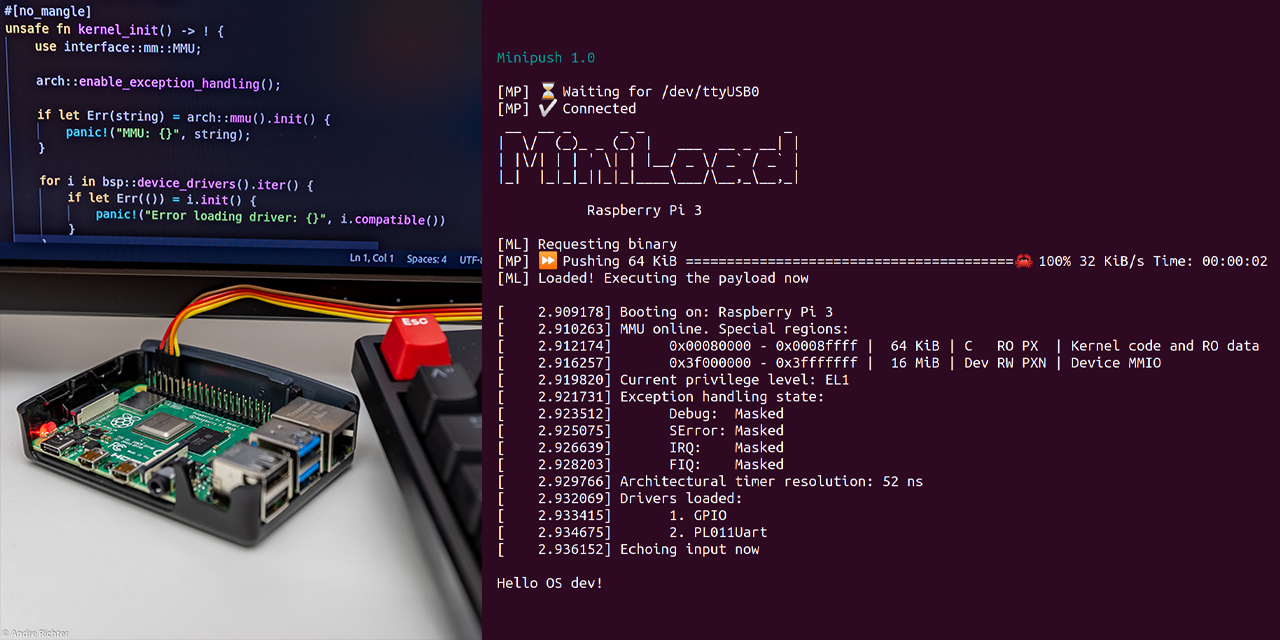
Hello all, Any idea from where I can get better hands-on experience in RPi bare metal? Wanted to learn from scratch, one of the colleague suggested try RPi bare metal - printing Hello world on RPi baremetal, then I'll get better idea about device drivers, cpu, systick, any other topics. Thanks in advance for your help!
Hello all, I want to use an adc ic to get audio data from mic but i don't find any suitable ic, can anyone help me in this problem? Thanks all for your help!
Oh there should be plenty to help out with this, DINO, but @Umesh Lokhande would probably have a good idea of where to start or some sessions we may be able to put together around the topic since he's built training sessions on Pi before.
PICO is a controller, I am currently learnig bare-metal for Nucleo L4 series via udemy course. Wanted to learn and explore processor bare-metal to strengthen the concepts of processors.
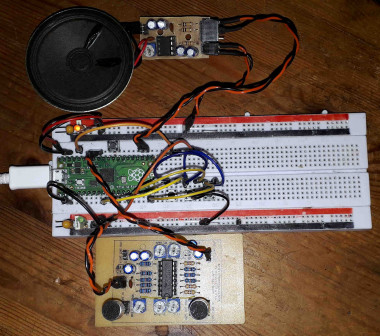
@Dũng I don't know that I've ever set up a microcontroller to record audio (just play it back), but I believe there are a lot of chips/boards that are capable or such operation. Searching around, here's one example with a Raspberry Pi Pico/RP2040 https://www.electromaker.io/project/view/raspberry-pi-pico-audio-recordplaywav-file of doing what I think you want to do, though there are a few external components involved. Also, IIRC, the RP2040 uses storage on an external chip, so you would need that available.
This project has been designed to be a very simple and easy to understand, audio recording and playback system. Using a Raspberry Pi Pico and C programming language. It has the added facility to also save WAV formatted files, which can be played directly on Linux, Windows & Mac OS.
I've been messing about with concepts related to 1 bit ADCs recently out of some curiosity
In playing around, I realised that when we are dealing with 1 bit signals, the and operator and multiplication are orthogonal i.e.
Now for a mixer, we want to multiply some signal, by some LO complex signal, and get the output mixed complex signal
So - the question becomes:
If I take a PDM (pulse density modulation) signal and LO, and them together - do I get a mixer.
The answer seems to be yes..
This is a little side tangent from a project where I am trying to make a 1 bit SDR, now I think I need to add as a stretch goal trying to make a digital mixer like this In theory, I can take a 1 bit signal into LVDS+ on an FPGA LVDS channel and inject whatever noise or signal on the other signal. To just make PDM, we want to put white noise in there, that works fine. But this tells me maybe there is an opportunity to make a mixer feeding PDM signals in instead of noise.
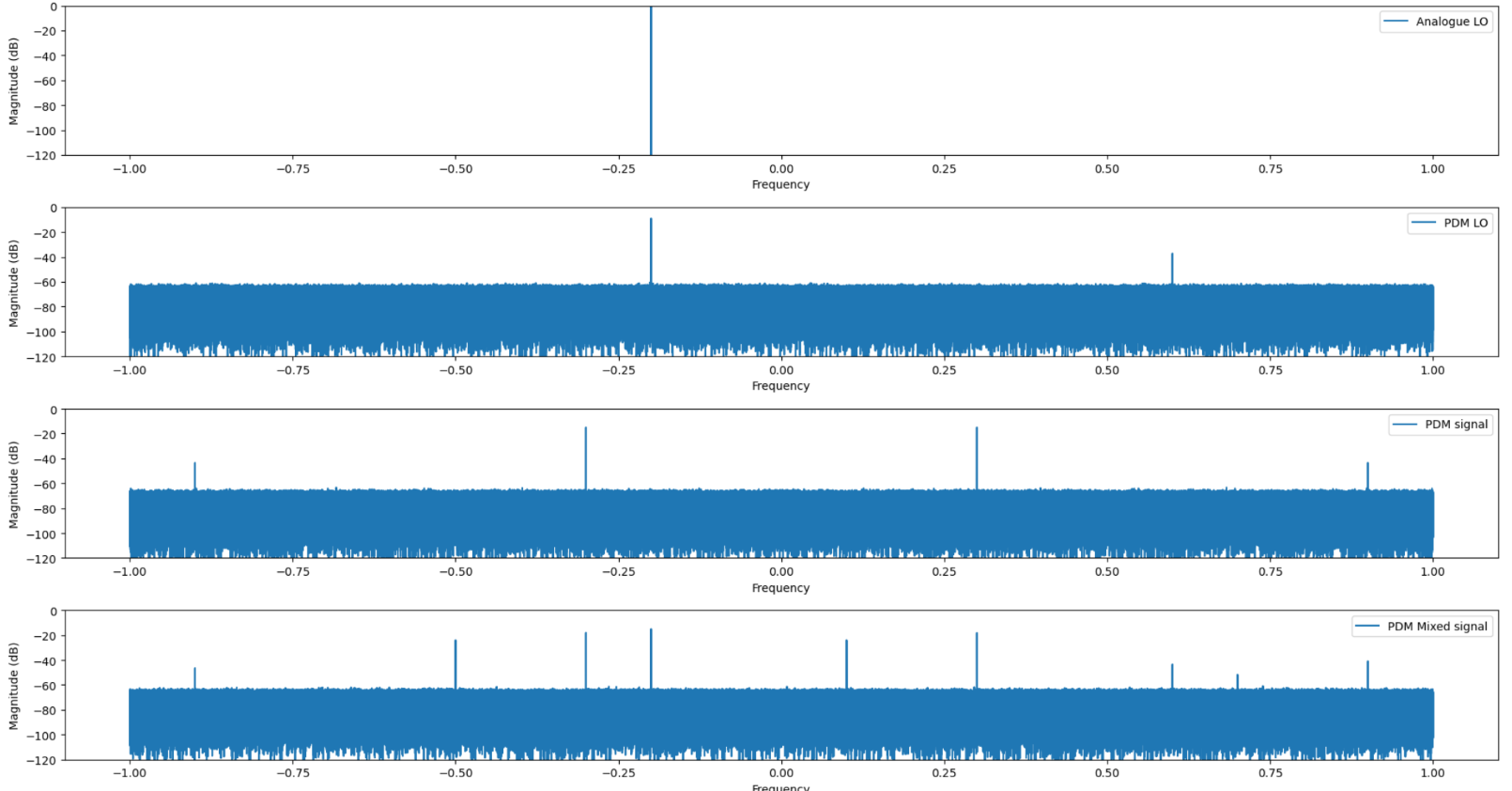
I wonder if anyone tried something like this or has some thoughts related to it. There is prior art for simply making 1 bit ADC using FPGA channels but I haven't found any literature related to this.
P.S. there are a lot of harmonics - they are mostly from the 1bit conversion and can be mitigated to some extent with MORE NOISE, I am ready to find out that even though it can kind of work, it cannot work well enough to ever be useful, but where is there is too much fun finding out the hard way
Can someone help me? I am using arduino uno r4 wifi. I want to change the wifi semi via iot remote arduino or blynk app. I am tired of searching. I did not find a clear way.
Can you explain this method to me more or send me a blog or a video clip that explains it, where do I get the OTA file from and how do I make it support arduino uno r4 wifi and how do I enter the wifi network name and password? Please, I really need this. I want to change the wifi network name and password on blynk or iot remote arduino through the phone application
PLEASE JOIN AS A SPEAKER IF YOU WANT TO PARTICIPATE IN THE DISCUSSION!Join DevHeads meetups to connect with other DevHeads and riff on a variety of topics for 30-60 minutes. Join here: https:...
That's a quite widespread(or lets say broadband ;)) question - interesting play you're into.
As I understand you want to make a 1 bit SDR having PDM signal generated again from a 1-bit ADC. Now you want to mix it with a LO which was fine, but also want to take PDM signal as a mixing reference?
If wanting for a SDR, how about converting your PDM with a low-pass filter or a CIC filter in digital logic implementation.
So why this is interesting is it implies I could mix digitally before conversion - I already have a pipeline established that can do nyquist zone selection and down conversion - but I have to do a bit of downconversion before the data is at a rate that I can run filters on it - that part of the chain is not flexible
If I can digitally mix at the fpga input pin with this technique I can work around that and make the whole receiver more configurable
An arduino uno rr4 wifi to blynk platform , dynamically changing the wifi network name and password without altering the code is feasible , just that it requires the use of a wifi provisioning feature, somewhat like a blynk edgent library. Heard of Blynk.Edgent? Dat is designed for dynamic wifi management, it will wat wil make this work